
OUPV License › Q170 › Flash Cards › Emergency Procedures
Emergency Procedures
147 cards. Read the full material.
46 CFR 185, § 185.202(a) — Notice of casualty. What does it provide?
(a) Immediately after the addressing of resultant safety concerns, the owner, agent, master, or person in charge of a vessel involved in a marine casualty shall notify the nearest Sector Office, Marine Inspection Office, or Coast Guard Group Office whenever a vessel is involved in a marine casualty consisting of:
(1) An unintended grounding, or an unintended strike of (allision with) a bridge;
(2) An intended grounding, or an intended strike of a bridge, that creates a hazard to navigation, the environment, or the safety of a vessel, or that meets any criterion of paragraphs (a)(3) through (a)(7) of this section;
(3) Loss of main propulsion or primary steering, or any associated component or control system, that reduces the maneuverability of the vessel;
(4) An occurrence materially and adversely affecting the vessel's seaworthiness or fitness for service or route, including but not limited to fire, flooding, failure of or damage to fixed fire extinguishing systems, lifesaving equipment, auxiliary power generating equipment, or bilge pumping systems;
(5) Loss of life;
(6) Injury that requires professional medical treatment (treatment beyond first aid) and, if the person is engaged or employed on board a vessel in commercial service, which renders the individual unfit to perform his or her routine duties; or
(7) An occurrence not meeting any of the above criteria but causing property damage in excess of $25,000. This damage includes the cost of labor and material to restore the property to its condition before the occurrence, but does not include the cost of salvage, cleaning, gas freeing, drydocking, or demurrage.
46 CFR 185, § 185.202(a)
46 CFR 185, § 185.202(b) — Notice of casualty. What does it provide?
(b) A vessel is excluded from the requirements of paragraphs (a)(5) and (a)(6) of this section with respect to the death or injury of shipyard or harbor workers when such accidents are not the result of either a vessel casualty (e.g., collision) or a vessel equipment casualty (e.g., cargo boom failure) and are subject to the reporting requirements of the Occupational Safety and Health Administration (OSHA) in 29 Code of Federal Regulations (CFR) part 1904.
46 CFR 185, § 185.202(b)
46 CFR 185, § 185.202(c) — Notice of casualty. What does it provide?
(c) Notice given as required by § 185.203 satisfies the requirement of this section if the marine casualty involves a hazardous condition.
46 CFR 185, § 185.202(c)
46 CFR 185, § 185.203 — Notice of hazardous conditions. What does it provide?
Whenever there is a hazardous condition, as defined by § 175.400 of this subchapter, on board the vessel, the owner, master, agent, or person in charge shall immediately notify the Captain of the Port of the port of place of destination and the Captain of the Port of the port or place in which the vessel is located of the hazardous condition.
46 CFR 185, § 185.203
46 CFR 185, § 185.206(a) — Written report of marine casualty. What does it provide?
(a) The owner, master, agent, or person in charge shall, within five days, file a written report of any marine casualty. This written report is in addition to the immediate notice required by 185.202. This written report must be delivered to a Coast Guard Sector Office, or Marine Inspection Office. It must be provided on Form CG-2692 (Report of Marine Accident, Injury, or Death), Supplemented as necessary by appended Forms CG-2692A (Barge Addendum) and CG-2692B (Report of Required Chemical Drug and Alcohol Testing Following a Serious Marine Incident).
46 CFR 185, § 185.206(a)
46 CFR 185, § 185.206(b) — Written report of marine casualty. What does it provide?
(b) If filed without delay after the occurrence of the marine casualty, the notice required by paragraph (a) of this section suffices as the notice required by § 185.202.
46 CFR 185, § 185.206(b)
46 CFR 185, § 185.208 — Accidents to machinery. What does it provide?
The owner, managing operator, or master shall report damage to a boiler, unfired pressure vessel, or machinery that renders further use of the item unsafe until repairs are made, to the OCMI at the port in which the casualty occurred or nearest the port of first arrival, as soon as practicable after the damage occurs.
46 CFR 185, § 185.208
46 CFR 185, § 185.210(a) — Alcohol or drug use by individuals directly involved in casualties. What does it provide?
(a) For each marine casualty required to be reported by § 185.202, the owner, agent, master, or person in charge of the vessel shall determine whether there is any evidence of alcohol or drug use by individuals directly involved in the casualty.
46 CFR 185, § 185.210(a)
46 CFR 185, § 185.210(b) — Alcohol or drug use by individuals directly involved in casualties. What does it provide?
(b) The owner, agent, master, or person in charge of the vessel shall include in the written report, Form CG 2692, submitted for the casualty information that:
(1) Identifies those individuals for whom evidence of drug or alcohol use, or evidence of intoxication, has been obtained; and
(2) Specifies the method used to obtain such evidence, such as personal observation of the individual, or by chemical testing of the individual.
46 CFR 185, § 185.210(b)
46 CFR 185, § 185.210(c) — Alcohol or drug use by individuals directly involved in casualties. What does it provide?
(c) An entry must be made in the Official Logbook if carried, pertaining to those individuals for whom evidence of intoxication is obtained. The individual shall be informed of this entry and the entry shall be witnessed by a second person.
46 CFR 185, § 185.210(c)
46 CFR 185, § 185.210(d) — Alcohol or drug use by individuals directly involved in casualties. What does it provide?
(d) If an individual directly involved in a casualty refuses to submit to, or cooperate in, the administration of a timely chemical test, when directed by a Coast Guard commissioned, warrant, or petty officer, or any other law enforcement officer authorized to obtain a chemical test under Federal, state, or local law, or by the owner, agent, master, or person in change, this fact must be noted in the Official Logbook, if carried, and in the written report (Form CG 2692), and will be admissible as evidence in any administrative proceeding.
46 CFR 185, § 185.210(d)
46 CFR 185, § 185.212 — Mandatory chemical testing following serious marine incidents. What does it provide?
A marine employer whose vessel is involved in a casualty or incident that is, or is likely to become, a serious marine incident as defined in § 4.03-2 of subchapter A of this chapter shall comply with the requirements of § 4.06 in subchapter A of this chapter.
46 CFR 185, § 185.212
46 CFR 185, § 185.220 — Records of a voyage resulting in a marine casualty. What does it provide?
The owner, agent, master, or person in charge of any vessel involved in a marine casualty for which a report is required under § 185.202 of this part shall retain all voyage records maintained by the vessel, including rough and smooth deck and engine room logs, bell books, navigation charts, navigation work books, compass deviation cards, gyrocompass records, stowage plans, records of draft, aids to mariners, night order books, radiograms sent and received, radio logs, crew and passenger lists and counts, articles of shipment, official logs, and other material that might be of assistance in investigating and determining the cause of the casualty. The owner, agent, master, other officer, or person responsible for the custody thereof, shall make these records available upon request, to a duly authorized investigating officer, administrative law judge, officer or employee of the Coast Guard.
46 CFR 185, § 185.220
46 CFR 185, § 185.230 — Report of accident to aid to navigation. What does it provide?
Whenever a vessel collides with a buoy, or other aid to navigation under the jurisdiction of the Coast Guard, or is connected with any such collision, the person in charge of such vessel shall report the accident to the nearest OCMI. No report on Form CG 2692 is required unless otherwise required under 185.202.
46 CFR 185, § 185.230
46 CFR 185, § 185.260(a) — Reports of potential vessel casualty. What does it provide?
(a) An owner, charterer, managing operator, or agent of a vessel shall immediately notify either of the following Coast Guard offices if there is reason to believe the vessel is lost or imperiled:
(1) The Coast Guard district rescue coordination center (RCC) cognizant over the area in which the vessel was last operating; or
(2) The Coast Guard search and rescue authority nearest to where the vessel was last operating.
46 CFR 185, § 185.260(a)
46 CFR 185, § 185.260(b) — Reports of potential vessel casualty. What does it provide?
(b) Reasons for belief that a vessel is in distress include, but are not limited to, lack of communication with or nonappearance of the vessel.
46 CFR 185, § 185.260(b)
46 CFR 185, § 185.260(c) — Reports of potential vessel casualty. What does it provide?
(c) The owner, charterer, managing operator, or agent notifying the Coast Guard under paragraph (a) of this section, shall provide the name and identification number of the vessel, a description of the vessel, the names or number of individuals on board, and other information that may be requested by the Coast Guard.
46 CFR 185, § 185.260(c)
46 CFR 185, § 185.280(a) — Official Logbook for foreign voyages. What does it provide?
(a) Every vessel on a voyage from a port in the United States to a foreign port except to a port in Canada, or vice versa, must have an Official Logbook.
46 CFR 185, § 185.280(a)
46 CFR 185, § 185.280(b) — Official Logbook for foreign voyages. What does it provide?
(b) The master shall make or have made in the Official Logbook the following entries:
(1) Each legal conviction of a seaman of the vessel and the punishment inflicted;
(2) Each offense committed by a seaman of the vessel for which it is intended to prosecute or to enforce under a forfeiture, together with statements about reading the entry and the reply made to the charge as required by 46 U.S.C. 11502;
(3) A statement of the conduct, character, and qualifications of each seaman of the vessel or a statement that the master declines to give an opinion about that conduct, character, and qualifications;
(4) Each illness of or injury to a seaman of the vessel, the nature of the illness or injury, and the medical treatment;
(5) Each death on board, with the cause of death, and if a seaman, the information required by 46 U.S.C. 10702:
46 CFR 185, § 185.280(b)
46 CFR 185, § 185.280(i) — Official Logbook for foreign voyages. What does it provide?
(i) The wages due to a seaman who dies during the voyage and the gross amount of all deductions to be made from the wages;
(ii) The sale of the property of a seaman who dies during the voyage, including a statement of each article sold and the amount received for the property;
(6) Each birth on board, with the sex of the infant and the name of the parents;
(7) Each marriage on board, with the names and ages of the parties;
(8) The name of each seaman who ceases to be a crew member (except by death), with the place, time, manner, and the cause why the seaman ceased to be a crew member;
(9) When a marine casualty occurs, a statement about the casualty and the circumstances under which it occurred, made immediately after the casualty when practicable to do so.
46 CFR 185, § 185.280(i)
46 CFR 185, § 185.506(a) — Passenger safety orientation. What does it provide?
(a) Except as allowed by paragraphs (b) and (c) of this section, before getting underway on a voyage or as soon as practicable thereafter, the master of a vessel shall ensure that suitable public announcements are made informing all passengers of the following:
(1) The location of emergency exits, survival craft embarkation areas, and ring life buoys;
(2) The stowage location(s) of life jackets;
(3) Either:
46 CFR 185, § 185.506(a)
46 CFR 185, § 185.506(i) — Passenger safety orientation. What does it provide?
(i) The proper method of donning and adjusting life jackets of the type(s) carried on the vessel including a demonstration of the proper donning of a lifejacket, or
(ii) That passengers may contact a crew member for a demonstration as appropriate, prior to beginning an oceans or coastwise voyage;
(4) The location of the instruction placards for life jackets and other lifesaving devices;
(5) That all passengers will be required to don life jackets when possible hazardous conditions exist, as directed by the master; and
(6) If the vessel is operating with reduced manning or equipment requirements in § 176.114 of this chapter.
(b) As an alternative to an announcement that complies with paragraph (a) of this section, the master or other designated person may—
(1) Prior to getting underway, deliver to each passenger or, on a vessel that does not carry vehicles and that has seats for each passenger, place near each seat, a card or pamphlet that has the information listed in paragraphs (a)(1) through (a)(6) of this section; and
(2) Make an abbreviated announcement consisting of:
(i) A statement that passengers should follow the instructions of the crew in an emergency;
(ii) The location of life jackets; and
(iii) That further information concerning emergency procedures including the donning of life jackets, location of other emergency equipment, and emergency evacuation procedures are located on the card or pamphlet that was given to each passenger or is located near each seat.
(c) Ferries operating on short runs of less than 15 minutes may substitute bulkhead placards or signs for the announcement required in paragraphs (a) and (b) of this section if the OCMI determines that the announcements are not practical due to the vessel's unique operation.
(d) The master of a vessel shall ensure that a passenger, who boards the vessel on a voyage after the initial public announcement has been made as required by paragraphs (a) or (b) of this section, is also informed of the required safety information.
(e) On a vessel on a voyage of more than 24 hours duration, passengers shall be requested to don life jackets and go to the appropriate embarkation station during the safety orientation. If only a small number of passengers embark at a port after the original muster has been held, these passengers must be given the passenger safety orientation required by paragraphs (a) or (b) of this section if another muster is not held.
46 CFR 185, § 185.506(i)
46 CFR 185, § 185.507(a) — Passenger egress drills. What does it provide?
(a) The master of a vessel described by 46 CFR 175.110(d) must conduct passenger emergency egress drills from the passengers' assigned overnight accommodation spaces prior to beginning an excursion with new passengers.
(1) If the passengers are not assigned an overnight accommodation space, the master of a vessel described by 46 CFR 175.110(d) must conduct passenger emergency egress drills from an accommodation space prior to beginning an excursion with new passengers.
(2) For the purposes of this section, excursion includes anytime the vessel gets underway, or anytime passengers remain overnight on the vessel.
46 CFR 185, § 185.507(a)
46 CFR 185, § 185.507(b) — Passenger egress drills. What does it provide?
(b) Passenger egress drills must be logged or otherwise documented for review by the Coast Guard upon request. The drill entry must include the following information:
(1) Date and time of the drill; and
(2) Number of drill participants.
46 CFR 185, § 185.507(b)
46 CFR 185, § 185.508(a) — Wearing of life jackets. What does it provide?
(a) The master of a vessel shall require passengers to don life jackets when possible hazardous conditions exist, including, but not limited to:
(1) When transiting hazardous bars and inlets;
(2) During severe weather;
(3) In event of flooding, fire, or other events that may possibly call for evacuation; and
(4) When the vessel is being towed, except a non-self-propelled vessel under normal operating conditions.
46 CFR 185, § 185.508(a)
46 CFR 185, § 185.508(b) — Wearing of life jackets. What does it provide?
(b) The master or crew shall assist each passenger in obtaining a life jacket and donning it, as necessary.
46 CFR 185, § 185.508(b)
46 CFR 185, § 185.510(a) — Emergency instructions. What does it provide?
(a) The master and crew of a vessel will be familiar with the content of and have mounted at the operating station, emergency instructions containing the actions to be taken in the event of fire, heavy weather, or man overboard conditions.
46 CFR 185, § 185.510(a)
46 CFR 185, § 185.510(b) — Emergency instructions. What does it provide?
(b) Except when in the judgment of the cognizant OCMI the operation of a vessel does not present one of the hazards listed, the emergency instruction placard should contain at least the applicable portions of the “Emergency Instructions” listed in § 185.512. The emergency instructions must be designed to address the particular equipment, arrangement, and operation of each individual vessel.
46 CFR 185, § 185.510(b)
46 CFR 185, § 185.510(c) — Emergency instructions. What does it provide?
(c) If the cognizant OCMI determines that there is no suitable mounting surface aboard the vessel, the emergency instructions need not be posted but must be carried aboard the vessel and be available to the crew for familiarization.
46 CFR 185, § 185.510(c)
46 CFR 185, § 185.512 — Recommended emergency instructions format. What does it provide?
An emergency instruction placard containing the following information will satisfy the requirements of § 185.510.
46 CFR 185, § 185.512
46 CFR 185, § 185.512(a) — Recommended emergency instructions format. What does it provide?
(a) Emergency instructions—(1) Rough weather at sea, crossing hazardous bars, or flooding. (i) Close all watertight and weathertight doors, hatches, and airports to prevent taking water aboard or further flooding in the vessel.
46 CFR 185, § 185.512(a)
46 CFR 185, § 185.512(ii) — Recommended emergency instructions format. What does it provide?
(ii) Keep bilges dry to prevent loss of stability due to water in bilges. Use power driven bilge pump, hand pump, and buckets to dewater.
(iii) Align fire pumps to use as bilge pump if possible.
(iv) Check all intake and discharge lines, which penetrate the hull, for leakage.
(v) Passengers must remain seated and evenly distributed.
(vi) Passengers must don life jackets if the going becomes very rough, the vessel is about to cross a hazardous bar, or when otherwise instructed by the master.
(vii) Never abandon the vessel unless actually forced to do so.
(viii) If assistance is needed follow the procedures on the emergency broadcast placard posted by the radiotelephone.
(ix) Prepare survival craft (life floats, (inflatable) rafts, (inflatable) buoyant apparatus, boats) for launching.
(2) Man overboard. (i) Throw a ring buoy overboard as close to the person as possible.
(ii) Post a lookout to keep the person overboard in sight.
(iii) Launch rescue boat and maneuver to pick up person in the water, or maneuver the vessel to pick up the person in the water.
(iv) Have crew member put on life jacket, attach a safety line to him or her, and have him or her stand by jump into the water to assist the person overboard if necessary.
(v) If person is not immediately located, notify Coast Guard and other vessels in vicinity by radiotelephone.
(vi) Continue search until released by Coast Guard.
(3) Fire. (i) Cut off air supply to fire—close items such as hatches, ports, doors, ventilators, and louvers, and shut off ventilation system.
(ii) Cut off electrical system supplying affected compartment if possible.
(iii) If safe, immediately use portable fire extinguishers at base of flames for flammable liquid or grease fires or water for fires in ordinary combustible materials. Do not use water on electrical fires.
(iv) If fire is in machinery spaces, shut off fuel supply and ventilation and activate fixed extinguishing system if installed.
(v) Maneuver vessel to minimize effect of wind on fire.
(vi) If unable to control fire, immediately notify the Coast Guard and other craft in the vicinity by radiotelephone.
(vii) Move passengers away from fire, have them put on life jackets, and if necessary, prepare to abandon the vessel.
(b) [Reserved]
46 CFR 185, § 185.512(ii)
46 CFR 185, § 185.514(a) — Station bill. What does it provide?
(a) A station bill must be posted by the master on a vessel of more than 19.8 meters (65 feet) in length having a Certificate of Inspection requiring more than four crew members at any one time, including the master.
46 CFR 185, § 185.514(a)
46 CFR 185, § 185.514(b) — Station bill. What does it provide?
(b) The station bill required by paragraph (a) of this section must set forth the special duties and duty station of each crew member for various emergencies. The duties must, as far as possible, be comparable with the regular work of the individual. The duties must include at least the following and any other duties necessary for the proper handling of a particular emergency:
(1) The closing of hatches, airports, watertight doors, vents, scuppers, and valves for intake and discharge lines that penetrate the hull, the stopping of fans and ventilating systems, and the operating of all safety equipment;
(2) The preparing and launching of survival craft and rescue boats;
(3) The extinguishing of fire; and
(4) The mustering of passengers including the following:
46 CFR 185, § 185.514(b)
46 CFR 185, § 185.514(i) — Station bill. What does it provide?
(i) Warning the passengers;
(ii) Assembling the passengers and directing them to their appointed stations; and
(iii) Keeping order in the passageways and stairways and generally controlling the movement of the passengers.
(c) The station bill must be posted at the operating station and in a conspicuous location in each crew accommodation space.
46 CFR 185, § 185.514(i)
46 CFR 185, § 185.515(a) — Passenger safety bill. What does it provide?
(a) On vessels described by 46 CFR 175.110(d) of this chapter, a passenger safety bill must be posted by the master in each cabin or stateroom, and in passenger accommodation spaces.
46 CFR 185, § 185.515(a)
46 CFR 185, § 185.515(b) — Passenger safety bill. What does it provide?
(b) Each passenger safety bill required by this section must list:
(1) The embarkation station and the number and location of the survival craft to which each passenger is assigned, if applicable;
(2) The fire and emergency signal and the abandon ship signal;
(3) Essential action that must be taken in an emergency; and
(4) If immersion suits are provided for passengers, the location of the suits and illustrated instructions on the method of donning the suits.
46 CFR 185, § 185.515(b)
46 CFR 185, § 185.516(a) — Life jacket placards. What does it provide?
(a) Placards containing instructions for the donning and use of the life jackets aboard the vessel must be posted in conspicuous places that are regularly accessible and visible to the crew and passengers.
46 CFR 185, § 185.516(a)
46 CFR 185, § 185.516(b) — Life jacket placards. What does it provide?
(b) If the cognizant OCMI determines that there is no suitable mounting surface aboard the vessel, the life jacket placards need not be posted but must be carried aboard the vessel and be available to the crew and passengers for familiarization.
46 CFR 185, § 185.516(b)
46 CFR 185, § 185.518(a) — Inflatable survival craft placards. What does it provide?
(a) Every vessel equipped with an inflatable survival craft must have approved placards or other cards containing instructions for launching and inflating inflatable survival craft for the information of persons on board posted in conspicuous places by each inflatable survival craft.
46 CFR 185, § 185.518(a)
46 CFR 185, § 185.518(b) — Inflatable survival craft placards. What does it provide?
(b) Under the requirement in § 160.051-6(c)(1) of this chapter, the manufacturer of approved inflatable liferafts is required to provide approved placards containing such instructions with each liferaft. Similar placards must be used for other inflatable survival craft.
46 CFR 185, § 185.518(b)
46 CFR 185, § 185.606 — Escape hatches and emergency exits. What does it provide?
All escape hatches and other emergency exits used as means of escape must be marked on both sides in clearly legible letters at least 50 millimeters (2 inches) high: “EMERGENCY EXIT, KEEP CLEAR”, unless such markings are deemed unnecessary by the cognizant OCMI.
46 CFR 185, § 185.606
46 CFR 185, § 185.608 — Fuel shutoff valves. What does it provide?
Remote fuel shutoff stations must be marked in clearly legible letters at least 25 millimeters (1 inch) high indicating purpose of the valve and direction of operation.
46 CFR 185, § 185.608
46 CFR 185, § 185.610 — Watertight doors and watertight hatches. What does it provide?
Watertight doors and watertight hatches must be marked on both sides in clearly legible letters at least 25 millimeters (1 inch) high: “WATERTIGHT DOOR—KEEP CLOSED” or “WATERTIGHT HATCH—KEEP CLOSED”, unless such markings are deemed unnecessary by the cognizant OCMI.
46 CFR 185, § 185.610
46 CFR 185, § 185.900 — Penalty for violations. What does it provide?
Violation of the provisions of this subchapter will subject the violator to the applicable penalty provisions of Subtitle II of Title 46, United States Code.
46 CFR 185, § 185.900
46 CFR 185, § 185.910 — Suspension and revocation. What does it provide?
An individual holding a merchant mariner credential, license, certificate of registry, or merchant mariner's document who commits an act of misconduct, negligence, or incompetence, or who violates or fails to comply with this subchapter or any other law or regulation intending to promote marine safety, is subject to proceedings under the provisions of 46 U.S.C. 7703 and part 5 of this chapter with respect to suspension or revocation of a merchant mariner credential, license, certificate, or document.
46 CFR 185, § 185.910
Safety Assessment and Management Guidelines — what does the handbook teach? (COMDTINST 16114.1B, ch. 5, A.1)
Emergency situations can cause people to panic or act before thinking despite the best of training and preparation. Therefore, boat crews must work together as a team to minimize any potential or immediate jeopardy for both civilian casualties and themselves. An emergency situation should never be entered without first: (01) Assessing the risk involved for the boat crewmembers and civilian victims (risk assessment). (02) Being aware of the dynamics of the emergency situation (situational awareness). (03) Implementing a control plan that fits each unique emergency (damage control risk management).
COMDTINST 16114.1B, ch. 5, A.1
Risk Assessment — what does the handbook teach? (COMDTINST 16114.1B, ch. 5, A.1.a)
Risk assessment starts with realizing why mishaps occur. The responsibility for identifying and managing risk lies with every member of a boat crew. Realistic training based on standard techniques, critical analysis, and debriefing missions will help every person in a boat crew to contribute to developing and implementing a risk management plan. A risk management plan identifies and controls risk according to a set of preconceived parameters. Refer to Reference (h) for a complete discussion of risk assessment and risk management plans.
COMDTINST 16114.1B, ch. 5, A.1.a
Situational Awareness — what does the handbook teach? (COMDTINST 16114.1B, ch. 5, A.1.b)
Situational awareness is an important skill to develop as part of learning risk assessment. Situational awareness is the accurate perception of factors and conditions affecting the boat crew at any given time during any evolution. More simply, situational awareness is knowing what is going on in the surrounding environment at all times. Any time there is an indication that situational awareness is about to be lost, a decision must be made as to whether or not to continue with the rescue attempt. Everyone in the crew owns some responsibility for making these important decisions. These decisions take the form of action/reaction and communication.
NOTE
Crews who have a high level of situational awareness perform in a safe manner.
COMDTINST 16114.1B, ch. 5, A.1.b
Damage Control Risk Management — what does the handbook teach? (COMDTINST 16114.1B, ch. 5, A.1.c)
The precautions listed below include many of the considerations that can form a basis for a general damage control risk management plan. Boat crews should keep in mind that each emergency situation will be unique; therefore the plan must only be used as a general guideline. The experience and knowledge of each boat crew should be merged into a risk management plan and used to fine-tune this list. (01) Attempt to account for all persons. (02) Ensure all persons onboard the vessel in distress have donned PFDs, if possible. (03) Attempt to have all lines (rigging, etc.) removed from the water to avoid fouling the propellers. (04) Maintain communications between the coxswain and crewmembers. (05) Have all required equipment tested and ready. (06) Approach distressed vessel with fenders rigged and lines at the ready. (07) Approach a vessel on fire from the windward side. (08) Remove survivors first, then back off, and evaluate the fire. (09) If the risk of explosion is not known (cannot determine what cargo is onboard), back off and do not attempt to fight the fire. (10) Situations may dictate that survivors enter water to be rescued. (11) When necessary, dewater the distressed vessel while keeping all equipment aboard the assisting vessel. (12) Always keep the Operational Commander or parent unit informed.
NOTE
For more information concerning Coast Guard fire fighting policy, see Reference (m).
COMDTINST 16114.1B, ch. 5, A.1.c
Plugs — what does the handbook teach? (COMDTINST 16114.1B, ch. 5, B.1)
The simplest method of stopping a small hole in wooden or metal hulls is to insert a plug or plugs. Plugs are usually made of a soft wood such as pine or fir. Plugs are used individually if they fit the hole, or in combination with other materials to make a better fit.
COMDTINST 16114.1B, ch. 5, B.1
Preparing Plug — what does the handbook teach? (COMDTINST 16114.1B, ch. 5, B.2)
Wrapping cloth around each plug before inserting them in the hole will help to keep the plug in place. It also fills the gaps between plugs.
COMDTINST 16114.1B, ch. 5, B.2
Inserting Plugs — what does the handbook teach? (COMDTINST 16114.1B, ch. 5, B.3)
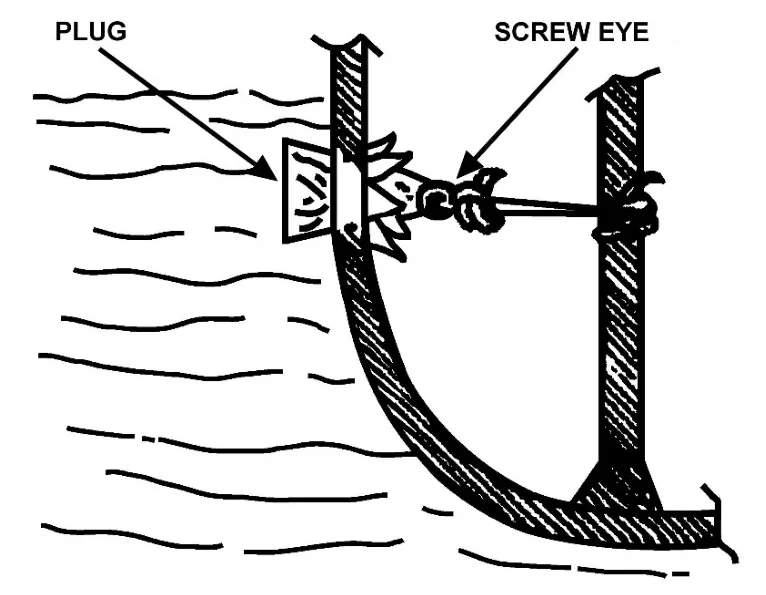
When plugging holes, it is usually easiest to insert the plugs from the inside. However, sometimes the rough edges protruding inward may make this method impossible. If it is necessary to insert the plugs from the outside, and safe to do so, the inboard end(s) of the plug(s) should be fitted with screw eyes. A line should be attached to each screw eye and fastened to a structure inside the boat. It will hold the plug in place (Figure 5-1).
COMDTINST 16114.1B, ch. 5, B.3
Large Holes — what does the handbook teach? (COMDTINST 16114.1B, ch. 5, B.4)
Large holes are generally too difficult to plug. A patch can be used to reduce the flow of water through a large hole, if an attempt is made.
COMDTINST 16114.1B, ch. 5, B.4
Fiberglass Hulls — what does the handbook teach? (COMDTINST 16114.1B, ch. 5, B.5)
Fiberglass may the most difficult hull material to plug. Wooden conical plugs driven into the hole may do nothing more than cause further splitting and cracking and add to an already difficult situation. The best method of plugging a hole in fiberglass is to shove some pliable type of material into it such as a rag, shirt, or piece of canvas. A PFD or a blanket may also work well.
COMDTINST 16114.1B, ch. 5, B.5
Holes Below the Waterline — what does the handbook teach? (COMDTINST 16114.1B, ch. 5, B.6)
Patching holes below the waterline is usually a difficult task because of the pressure exerted by the water and the inaccessibility to the holed area. Small holes should be patched from the inside. Some type of material should be placed over the hole and hold it in place with another object. For example, if the boat were holed in the bottom, a PFD or seat cushion could be placed over the hole and held in place with a gas can, cooler, or toolbox.
COMDTINST 16114.1B, ch. 5, B.6
Large Holes Below the Waterline — what does the handbook teach? (COMDTINST 16114.1B, ch. 5, B.7)
Large holes below the waterline are extremely difficult to patch. The pressure of the water flowing through the hole will not usually allow a patch to be installed from the inside.
COMDTINST 16114.1B, ch. 5, B.7
Collision Mat — what does the handbook teach? (COMDTINST 16114.1B, ch. 5, B.7.a)
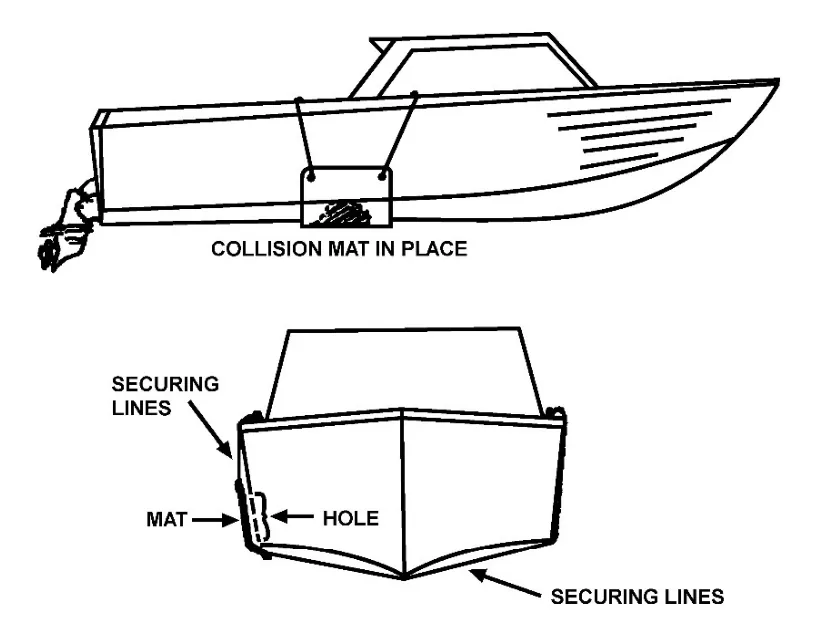
If a collision mat (a large piece of canvas or vinyl) is available, it can be used to patch a large hole (Figure 5-2). Perform the following the procedures while placing the mat over the hole:
| Step | Procedure |
| 1 | Tie four lines to the corners of the mat (patch). |
| 2 | Position the mat by lowering it over the bow. |
| 3 | Have someone walk down each side of the boat, two of the lines for each person. |
| 4 | Slide the mat along the bottom of the boat. |
| 5 | Once the mat covers the hole, secure the four lines topside. The pressure of the water against the patch will also help to hold it in place. |
COMDTINST 16114.1B, ch. 5, B.7.a
Holes above the Waterline — what does the handbook teach? (COMDTINST 16114.1B, ch. 5, B.8)
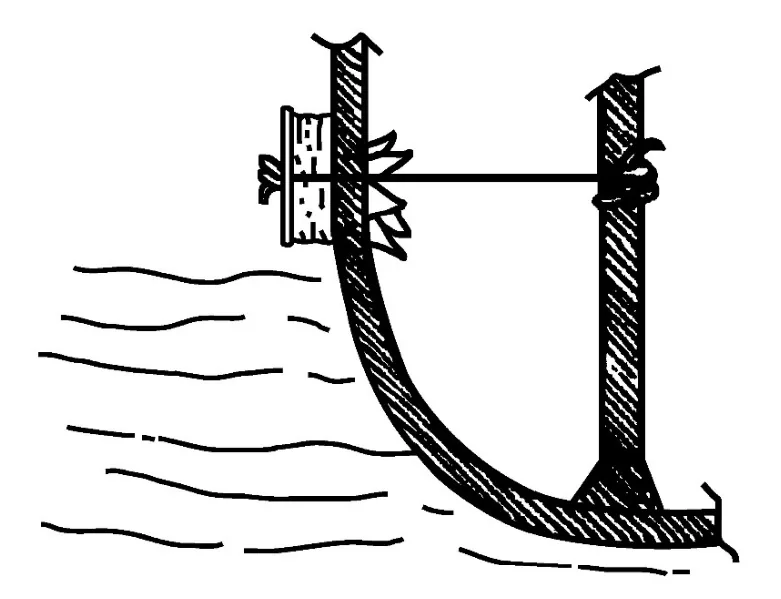
Holes above the waterline may be more dangerous than they appear. As the boat rolls, they admit water into the boat above the center of gravity. This water reduces the stability of the boat. Plugs or patches (Figure 5-3) on the inside or outside the hull should be used to cover these types of holes. The following procedures are an effective method for patching holes above the waterline:
| Step | Procedure |
| 1 | Use a pillow, spare PFD or cushion that has a small hole punched in the center. |
| 2 | Place the cushion over the holed area from the outside and back it with a board of the same approximate size. The board should also have a small hole through the center. |
| 3 | Pass a line through the board and cushion and knot the end of the line outside the board. |
| 4 | Secure the entire patch by attaching the other end of the line to something firm inside the boat. |
COMDTINST 16114.1B, ch. 5, B.8
Cracks in Hulls — what does the handbook teach? (COMDTINST 16114.1B, ch. 5, B.9)
To patch a crack in the hull, use the following procedures:
| Step | Procedure |
| 1 | Stuff the crack with something pliable such as a rag or line. |
| 2 | Place a piece of canvas or rubber over the crack to serve as a gasket. |
| 3 | Back the patch with a solid object such as a piece of plywood, panel door, or similar material. |
| 4 | Use nails, screws, or wedges to hold the patch in place. |
| 5 | To prevent the crack from traveling, especially in fiberglass, drill holes at each end of the crack. These holes will relieve the pressure at the ends of the crack, permitting the hull to flex without extending the crack. |
COMDTINST 16114.1B, ch. 5, B.9
Introduction — what does the handbook teach? (COMDTINST 16114.1B, ch. 5, B.10)
Dewatering a vessel is normally secondary to putting out the fire, but it remains an important follow-on consideration. Indeed, it may be possible to use dewatering equipment to keep the boat from capsizing. Know what equipment is available for dewatering and how to use it.
COMDTINST 16114.1B, ch. 5, B.10
Action Before Dewatering — what does the handbook teach? (COMDTINST 16114.1B, ch. 5, B.11)
Action taken before beginning to dewater a disabled vessel varies depending upon the nature of flooding. Regardless, a coxswain should always brief crewmembers on what procedures to follow while emphasizing safety. If crewmembers have just put out a fire on a boat, someone must then board the vessel and check for flooding, but only when safety permits. A coxswain will direct crewmembers how to safely accomplish this inspection for flooding.
COMDTINST 16114.1B, ch. 5, B.11
Initial Actions on Scene — what does the handbook teach? (COMDTINST 16114.1B, ch. 5, B.11.a)
When responding to a distress call of a disabled vessel taking on water, the initial action on the scene will be as follows:
| Step | Procedure |
| 1 | Search the immediate area for people in the water. |
| 2 | After all survivors are recovered and all persons onboard the sinking craft are accounted for and have been evacuated to a safe place, check the sinking craft for hull damage or other sources of flooding. |
| 3 | Before entering any flooded compartment/vessel, every attempt to secure electrical power should be made to reduce the chance of electrical shock. | ||
| 4 | Once a source of flooding is determined, crewmembers may perform procedures to reduce water flow into the boat. Safety of the crew is the first priority. The distressed vessel should not be boarded if it seems unstable and could possibly capsize or sink. | ||
| 5 | Once onboard, the crewmembers shall wear PFDs and not go below decks if there is any threat of capsizing or sinking. | ||
| 6 | When flooding has been controlled, or at least reduced to a minimum, dewatering can begin. How a vessel is dewatered depends on the conditions that exist at the scene. |
This handbook does not cover technical information and use of commercial gasoline
NOTE
powered pumps, high capacity, manual, or electrical bailing pumps. See and follow the manufacturing instructions for usage while dewatering.
COMDTINST 16114.1B, ch. 5, B.11.a
Dewatering with an Eductor — what does the handbook teach? (COMDTINST 16114.1B, ch. 5, B.12)
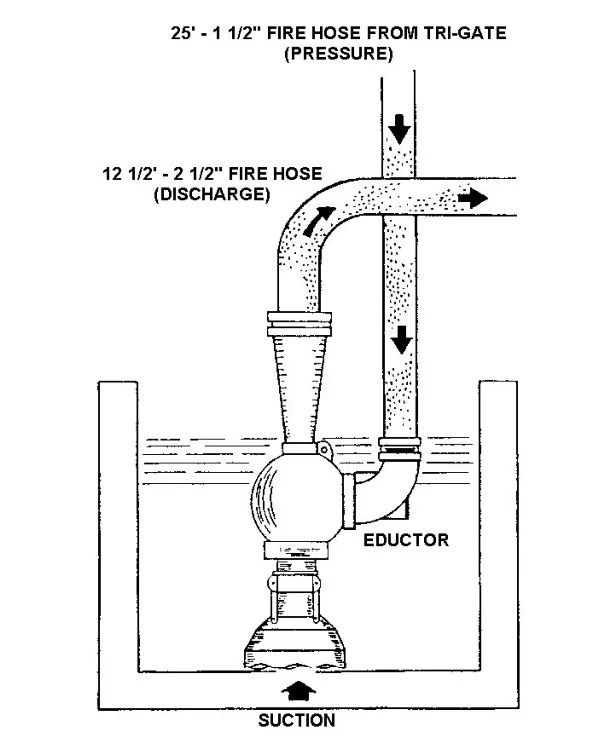
Dewatering with an eductor can be performed only when weather conditions permit your boat to safely come alongside a disabled vessel and remain close to it. An eductor is used in conjunction with the fire pump on the boat. A 1½-inch fire hose attached to one of the 1½-inch outlets of the fire main is connected to the pressure supply inlet of the eductor. A 2½-inch fire hose is connected to the discharge outlet. The eductor itself is submerged, either vertically or horizontally, in the flooded area to be dewatered. Suction is obtained in either position because of uneven edges of the suction end of an eductor. All eductors operate in fundamentally the same manner. Water from a boat’s fire pump is forced through a fire main and out through the discharge hose. As pressure of this rapidly moving water passes over the suction opening, it creates a vacuum. The vacuum, or suction, pulls water up through a suction hose, out through the discharge hose, and over the side of the boat. A discharge hose must always lead over the side and a suction hose must always be placed in flooded areas of a disabled boat. If they are inadvertently reversed, a disabled vessel will quickly be filled with water pumped aboard through the discharge line instead of dewatering it with a suction line (Figure 5-4).
CAUTION !
Make certain there are no kinks or obstructions in a discharge line. Their presence will cause an eductor to pump water into a flooded boat through the suction line.
COMDTINST 16114.1B, ch. 5, B.12
Dewatering Using a Drop Pump — what does the handbook teach? (COMDTINST 16114.1B, ch. 5, B.13)
Many first responder boats carry a portable, gasoline-powered drop pump (Figure 5-5). Dewatering with a drop pump is done with the pump placed on the disabled boat. Depending on the model of drop pump, approximately 100-250 gallons of water per minute (GPM) can be removed from a flooded compartment.
WARNING
Since the drop pump is water cooled, it should not be used to dewater a boat with fuel contamination in its bilges.
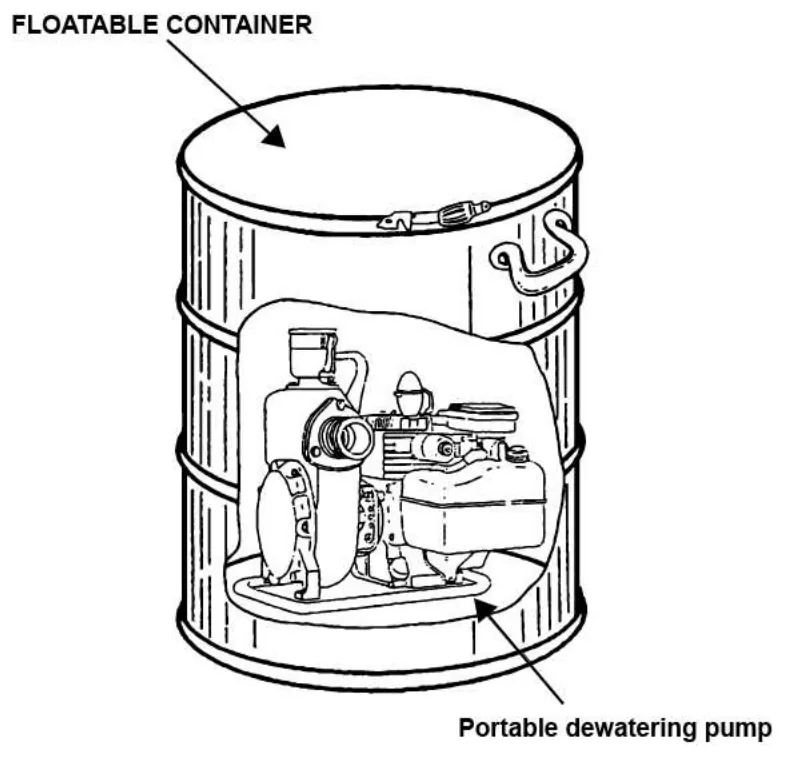
COMDTINST 16114.1B, ch. 5, B.13
Pump Operation — what does the handbook teach? (COMDTINST 16114.1B, ch. 5, B.13.a)
Since the agencies switch out models of drop pumps when newer models become available, every drop pump comes with instructions specifically designed for that model pump. These instructions for operation can be found inside the storage container. These are extremely helpful if the pump is transferred to another vessel to use. All crewmembers should be familiar with these instructions and practice operating the drop pump often. The following procedures are the basic steps for setting up and using a drop pump (Figure 5-6). Again, refer to the instructions that come with the pump for specific operation instructions. Breathing exhaust fumes can be dangerous. Do not attempt to start or operate a pump
CAUTION !
while it is in a container. Once a pump is started, ensure sufficient ventilation is present to allow exhaust gases to dissipate into the atmosphere. Do not operate a drop pump below deck.
| Step | Procedure |
| 1 | Pull the handle to release the tension ring or undo the locking clips on the storage container. |
| 2 | Lift the lid and open the plastic bag. Lift out the drop pump, hoses, and fuel. |
| 3 | Check the engine oil level (oil must be visible). |
| 4 | Check the fuel tank (fill if needed) and then connect fuel line to the fuel tank. |
| 5 | If applicable, open fuel vent cap by turning counterclockwise. |
| 6 | Connect the discharge hose and lay it out on deck so there are no kinks or twists. During operation, the discharge hose should be manned or tied off to prevent flooding into another space. |
| 7 | Attach connection end of suction hose to pump and lower strainer end into compartment to be dewatered. |
| 8 | Turn the engine IGNITION switch to the “ON” position. |
| 9 | Open the fuel valve on the engine by pushing it to right into the “ON” position. |
| 10 | Move the chock level to the “CLOSED” position. |
| 11 | Set throttle to about 1/3 open. |
| 12 | Prime the pump by rapidly cycling the hand primer handle in and out until water is discharged from the primer cylinder cap. |
| 13 | Start the pump by pulling the recoil starter rope. |
| 14 | Move the choke lever to the “OPEN” position once the engine starts. |
| 15 | Check for water from the discharge hose. |
| 16 | Rapidly cycle the hand primer handle until water is flowing from the discharge hose. |
| 17 | Move throttle through its full range accordingly, checking for maximum flow output. |
| 18 | Post a watch on the pump. The engine will run approximately 4-5 hours on one tank of fuel. The pump watch must be alert for debris around the strainer and must ensure the strainer remains submerged. Watch for fuel leaks. |
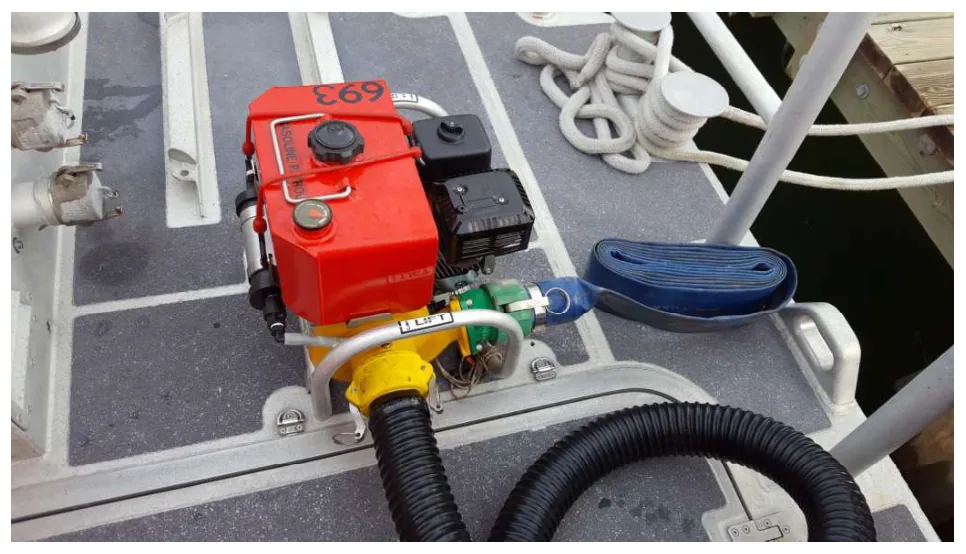
COMDTINST 16114.1B, ch. 5, B.13.a
Passing a Drop Pump — what does the handbook teach? (COMDTINST 16114.1B, ch. 5, B.13.b)
When secured in its watertight container, a drop pump can be easily passed from one boat to another. There are two methods for passing a pump.
COMDTINST 16114.1B, ch. 5, B.13.b
Directly Passing a Drop Pump — what does the handbook teach? (COMDTINST 16114.1B, ch. 5, B.13.b.1)
The easiest method for transferring a drop pump is to pull alongside the flooding vessel and simply transfer the pump to the other vessel. At least two people are always required to move a pump because it is heavy and awkward to carry. If coming alongside is not a safe option, use the following procedures to directly pass a drop pump:
| Step | Procedure | |
| 1 | Determine the rate of drift. | |
| 2 | Secure a 2-inch mooring line to a bridle attached to a pump container or pump container handles (Figure 5-7). | |
| 3 | Secure a heaving line to the mooring line. | |
| 4 | Rig a tending line from the pump to the boat to enable controlling the pump’s movement once it is in the water and hauling it back in the event of an emergency (Figure 5-8). | |
| 5 | Cast the heaving line, and direct people aboard the disabled boat to haul it in. | |
| 6 | Lower the drop pump overboard and direct people aboard the disabled boat to haul in on the line. Pay out the tending end of the line as it is being hauled in. |
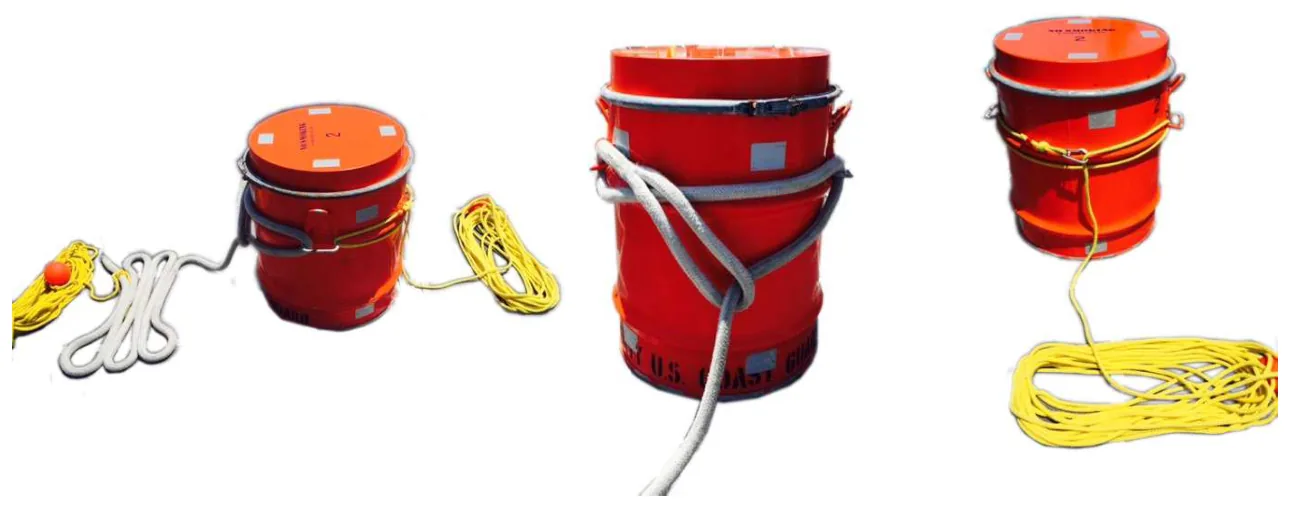
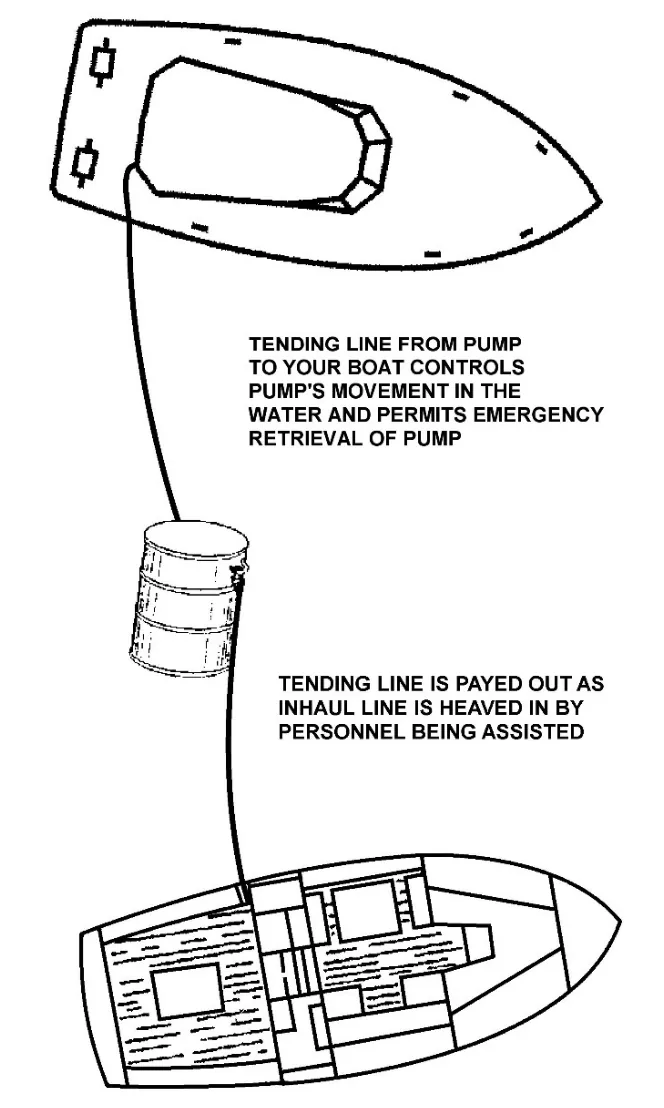
COMDTINST 16114.1B, ch. 5, B.13.b.1
Passing a Drop Pump into a Boat in Tow — what does the handbook teach? (COMDTINST 16114.1B, ch. 5, B.13.b.2)
If it becomes necessary to dewater a vessel during a tow, it is easier to transfer the drop pump before placing the vessel in tow. If for some reason the disabled vessel starts taking on water during the tow, use the following procedures to pass the drop pump to the boat in tow astern:
| Step | Procedure |
| 1 | Rig a bridle to both handles of a pump storage bracket if a permanent bridle has not already been attached. |
| 2 | Estimate the distance from the bow of the vessel back to the lowest point along the side of its hull. Make up a length of mooring line approximately equal to this distance. Secure the mooring line to the bridle rigged in step 1 with a shackle. |
| 3 | Make a bowline in the other end of the mooring line around the towline. A shackle may be substituted for a bowline. Regardless of the device used, bow line or shackle, the opening must be large enough for the mooring line to run freely down the tow line (Figure 5-9). |
| 4 | Lower the pump over the leeward side and allow it to float back to the boat in tow (Figure 5-10). |
| 5 | Maintain only enough headway for steerage to keep the pump from submerging. |
| 6 | Instruct the vessel in tow to turn their rudder so as to head into the wind or current. This allows the pump to drift away from the towed vessel’s bow and down its side unobstructed. |
NOTE
Risk assessment is important should the towed vessel start to take on water. Always consider removing personnel from the vessel.
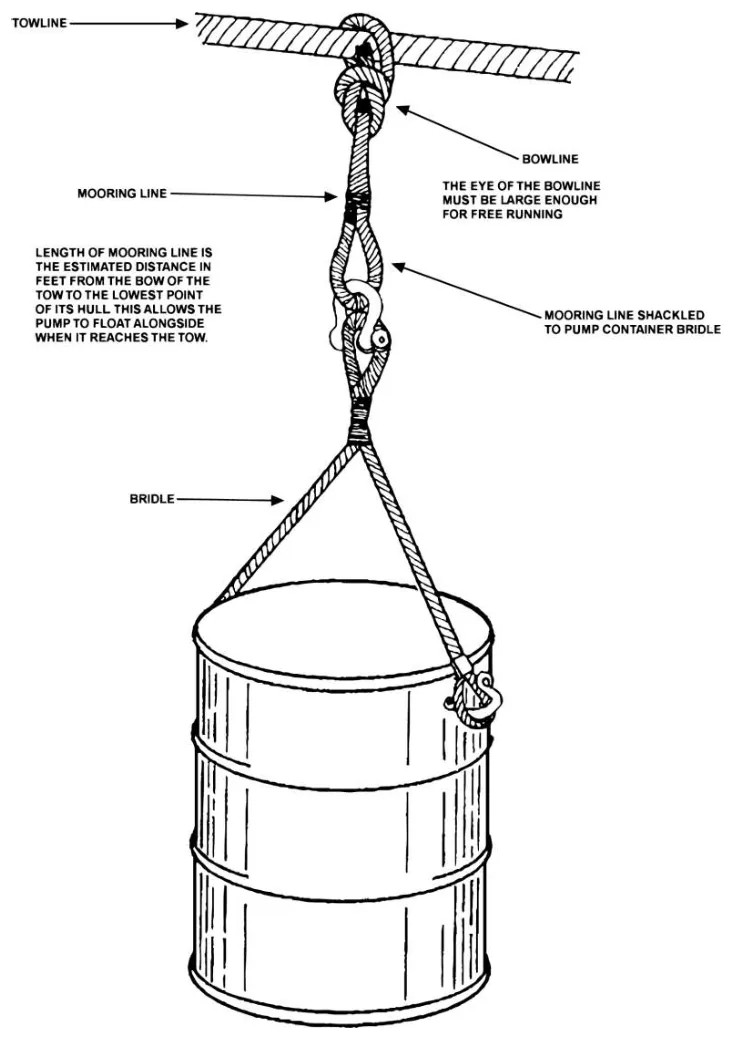
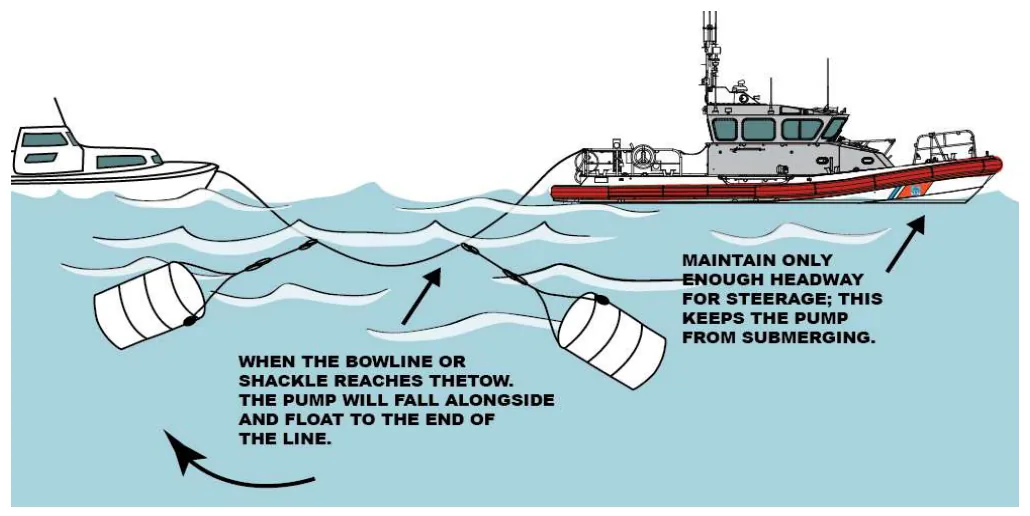
COMDTINST 16114.1B, ch. 5, B.13.b.2
Securing a Pump — what does the handbook teach? (COMDTINST 16114.1B, ch. 5, B.13.c)
There are separate procedures for securing a drop pump depending on whether it is being secured because of an emergency or to be stowed.
COMDTINST 16114.1B, ch. 5, B.13.c
Securing in an Emergency — what does the handbook teach? (COMDTINST 16114.1B, ch. 5, B.13.c.1)
Perform the following procedures for securing:
| Step | Procedure |
| 1 | Turn the engine IGNITION switch counterclockwise to the “OFF” position. If engine fails to secure, disconnect quick fuel fitting from the fuel tank. |
COMDTINST 16114.1B, ch. 5, B.13.c.1
Securing for Storage — what does the handbook teach? (COMDTINST 16114.1B, ch. 5, B.13.c.2)
Perform the following the procedures when securing the pump for storage:
| Step | Procedure |
| 1 | Disconnect the fuel line from fuel tank. |
| 2 | If applicable, turn fuel tank cap clockwise to close vent valve. |
| 3 | Continue to pump water until the engine stops from lack of fuel. |
| 4 | Close fuel valve by pushing it to the “OFF” position. |
| 5 | Turn the engine IGNITION switch counter clockwise to the “OFF” position. |
| 6 | Disconnect the suction/discharge hoses from the pump. Allow hoses to drain completely. |
| 7 | Drain water from the impeller case by tipping the pump towards the discharge outlet. |
| 8 | Cycle the hand primer pump to discharge residual water. |
| 9 | Check engine oil and fuel tank levels. Refill as required. |
| 10 | Allow the engine, pump, hoses, and associated kit components to completely dry. |
| 11 | After drying, re-stow all gear in accordance with maintenance procedure card. |
COMDTINST 16114.1B, ch. 5, B.13.c.2
Closing and Opening Watertight Doors and Hatches — what does the handbook teach? (COMDTINST 16114.4A, ch. 3, C.1)
Watertight doors and hatches will retain their efficiency longer and require less maintenance if they are properly closed and opened as described below.
COMDTINST 16114.4A, ch. 3, C.1
Closing — what does the handbook teach? (COMDTINST 16114.4A, ch. 3, C.1.a)
The procedures for closing a watertight door are as follows:
| Step | Procedure |
| 1 | Begin by tightening a dog that is opposite the hinges. |
| 2 | Place just enough pressure on the dog to keep the door shut. |
| 3 | Tighten up the other dogs evenly to obtain uniform pressure all around the closing device. |
For quick-acting watertight doors, the wheels or handles are turned in the correct direction (clockwise).
COMDTINST 16114.4A, ch. 3, C.1.a
Opening — what does the handbook teach? (COMDTINST 16114.4A, ch. 3, C.1.b)
If the dogs on watertight doors and hatches open individually, the dog nearest the hinge is opened first. This keeps the closing device from springing and makes loosening the other dogs easier. For quick-acting watertight doors, the wheels or handles are turned in the correct direction (counterclockwise).
COMDTINST 16114.4A, ch. 3, C.1.b
Entering a Closed Compartment After Damage — what does the handbook teach? (COMDTINST 16114.4A, ch. 3, C.2)
Watertight doors, hatches, and scuttle covers on a damaged boat must not be opened until the following is determined: (01) Flooding did not occur or, if flooded, (02) Further flooding will not occur if the closure is opened.
CAUTION !
Extreme caution is always necessary when opening compartments below the waterline near hull damage.
NOTE
Suspect flooding if air escapes when the dogs on a door or hatch are released.
COMDTINST 16114.4A, ch. 3, C.2
Introduction — what does the handbook teach? (NAVEDTRA 12018, ch. 19, Introduction)
I wish to have no connection with any ship that does not sail fast for I intend to go in harms way.
Naval warships are inherently dangerous. Crowded living conditions, confined working spaces, and long hours, often at night, are just a few reasons why you must use caution at all times. Some evolutions, such as underway replenishment, conducting flight operations, testing weapons systems, or just a change in weather conditions, greatly increase the dangers of being at sea. All Navy ships have a comprehensive shipboard safety program. This program was developed over many years to make life at sea safe. This program is designed to follow established procedures in conducting the day-to-day business aboard ship, and it places special emphasis on observing certain precautions.
The safety program stresses constant awareness of the hazards of being at sea. The word mishap is often used in referring to an incident that just happened. Mishaps don’t just happen; they are caused. Most mishaps could have been prevented if the individuals involved had followed established procedures and safety precautions.
Most of the precautions discussed in this chapter are from a shipboard viewpoint, but many of them also apply ashore. Don’t depend on memory to remember safety precautions. Almost every task you perform has safety precautions that must be followed. Get the operator’s manual, planned maintenance system (PMS) card, or technical manual and read these precautions. If you don’t understand them or can’t find them, ask your supervisor for help. The few minutes you take to read and understand these safety precautions will make your job safer. Don’t be one of the casualties reported during a mishap. It’s better to be safe than hurt or possibly worse—dead!
NAVEDTRA 12018, ch. 19, Introduction
Personal Responsibility — what does the handbook teach? (NAVEDTRA 12018, ch. 19, Personal Responsibility)
Learning Objective: When you finish this chapter, you will be able to—
• Recognize that safety is a personal responsibility.
—John Paul Jones
Your personal responsibilities for safety are as follows:
• Observe all safety precautions related to your work or duties.
• Report unsafe conditions. Do not walk around a ladder well with missing safety chains and forget it. Report it! If you use a piece of equipment that is damaged, report it!
• Warn others of hazards. If you see someone knowingly, or unknowingly, placing themselves or others in danger, say something. If that particular person will not listen, tell your supervisor.
• Protective equipment and clothing is issued to you for a purpose—use them.
• Wear eye and/or full-face protection. It’s hard to explain to the chief that you had to go to sick bay to get something removed from your eye when you were given a full-face shield before you started working.
• Report all injuries or illnesses. If you should become injured or feel sick, tell your supervisor. A little scratch could become infected or your illness could be a sign of something more serious. A little time having the corpsman check you now is better than being in the hospital later.
• Remain alert. Look for any possibilities of danger. Be safety conscious.
• Don’t rush into a job. Look at what you are supposed to do. Is the equipment you have suited to the job? Check the safety precautions for the equipment you were issued. Is the equipment in good condition?
A shipboard environment introduces factors affecting safety that are not found ashore. Danger exists in every naval operation and aboard every naval vessel. Going to sea involves working with powerful machinery; high-speed equipment; high-temperature, high-pressure steam; volatile fuels and propellants; heavy lifts; high explosives; stepped-up electrical voltages; and the unpredictable forces of wind and waves.
Underway refueling, multiship exercises, storms, and other situations require personnel at sea to be constantly alert. A mishap (there’s that word again) at sea can involve all hands in a matter of seconds. Therefore, you must be continually alert to hazardous conditions. If you observe unsafe practices or conditions, report them to your supervisors.
NAVEDTRA 12018, ch. 19, Personal Responsibility
Review 1 Questions — what does the handbook teach? (NAVEDTRA 12018, ch. 19, Review 1 Questions)
Q1. List some of the safety precautions that could save you and your shipmate’s life. a. b. c. d. e.
Q2. What are some shipboard environments that are dangerous? a. b. c. d. e. f. g. h.
NAVEDTRA 12018, ch. 19, Review 1 Questions
Safety Precautions and Hazards to Safety — what does the handbook teach? (NAVEDTRA 12018, ch. 19, Safety Precautions and Hazards to Safety)
Learning Objectives: When you finish this chapter, you will be able to—
• Recall the purpose and use of Material Safety Data Sheets (MSDS).
• Recognize safety precautions when you are embarked in a small boat.
• Recognize the purpose of safety precautions when working around various equipment and working in spaces to include the following: steam; lifelines, ladders, and scaffolding; heavy weight and moving equipment; personnel aloft or over the side; antennas; flammable liquids, paints, and solvents; weapons, ammunition, and explosives; electrical and electronic equipment; compressed gases; fiber glass and asbestos; power tools; cutting and welding operations; liquids under pressure; rotating machinery; marine sanitation systems; high noise levels; lifting objects; shipyards and docks; aircraft and flight deck operations; when involved in sporting and recreational events; and operating motor vehicles. The safety precautions and hazards discussed are of a general nature only. Following them will help you to avoid injury to yourself and others and to prevent loss of or damage to equipment.
NAVEDTRA 12018, ch. 19, Safety Precautions and Hazards to Safety
Material Safety Data Sheet (msds) — what does the handbook teach? (NAVEDTRA 12018, ch. 19, Material Safety Data Sheet (msds))
Material Safety Data Sheets (MSDS) are technical bulletins that contain information about hazardous material (figs. 19-1 and 19-2). Manufacturers create MSDSs based on their testing and research of their products. By law, manufacturers must provide the data to hazardous material users. They tell users how to use, store, and dispose of hazardous material. According to OPNAVINST 5100.19, all hands are required to follow these guidelines. MSDSs must be in English and contain at least the following information about the material:
• Identity
• Hazardous ingredients
• Physical and chemical characteristics
• Physical hazards
• Reactivity
• Health hazards
• Precautions for safe handling and use
• Control measures
• Routes of entry into the body
• Emergencyand first-aid procedures forexposure
• Date of preparation ofthe MSDS orlast change
• Name, address, and phone number of a responsible party who can provide additional information on the hazardous material and appropriate emergency procedure Manufacturers may use any format or arrangements of this information, but every MSDS must include all the items. Every hazardous material user must be trained on the precautions associated with that material. MSDSs must be available upon request to any user. If you have a question, check with your command’s hazardous material/hazardous waste coordinator.
[An illustration in the course, not reproduced here: Figure 19-1.—Material Safety Data Sheet (front).]
[An illustration in the course, not reproduced here: Figure 19-2.—Material Safety Data Sheet (back).]
NAVEDTRA 12018, ch. 19, Material Safety Data Sheet (msds)
Review 2 Questions — what does the handbook teach? (NAVEDTRA 12018, ch. 19, Review 2 Questions)
Q1. Manufacturers provide data to people who use hazardous materials. What publication contains information on using, storing, and disposing of hazardous materials?
Q2. What instruction dictates that all hands are to follow Material Safety Data Sheets guidelines?
NAVEDTRA 12018, ch. 19, Review 2 Questions
Boat Safety — what does the handbook teach? (NAVEDTRA 12018, ch. 19, Boat Safety)
The major concern of Navy personnel aboard small boats is safety—for passengers and crew members. This section covers safety precautions to follow aboard small boats. Every Sailor should be thoroughly familiar with boat safety precautions. When you are on or boarding a boat, observe the following precautions:
• Obey all orders from the coxswain.
• Embark in a quiet, orderly manner and move as far forward as possible. Once embarked, stay in place.
• Keep all parts of your body in the boat; do not sit on gunwales.
• Don’t engage in horseplay.
• Never distract the attention of crew members from their duties.
• Don’t sit on life jackets; this will compress the filler and reduce buoyancy.
• When told to do so, don your life jacket immediately.
• Don’t smoke in a boat.
• If told to embark or disembark, do so without argument. During heavy weather, boat loads will be reduced.
• If a boat swamps or capsizes, do not panic. Fear can spread quickly from person to person. A terrified person drowns easily. Stay with the boat or huddle with other passengers. A large group can be found much easier than individual swimmers.
NAVEDTRA 12018, ch. 19, Boat Safety
Deck Safety — what does the handbook teach? (NAVEDTRA 12018, ch. 19, Deck Safety)
Weather decks of ships at sea are extremely hazardous places, particularly aboard small ships. The ship may be level one minute and take a sharp roll the next. At any moment, a large wave could submerge the main deck to a depth of several feet, or a wave could come unexpectedly over the fantail.
Vigilance (alertness) is always a necessity aboard ship. In foul weather, you must be even more alert. If your duties don’t require your presence on the main deck, don’t go there. Use interior passageways or superstructure decks for moving about the ship. When you must be on the main deck in foul weather, wear your life jacket. You must always wear an inherently buoyant life jacket whenever you are handling lines or are otherwise involved in underway replenishment or transfer operations.
A ship’s deck has many tripping hazards, such as cleats, bitts, and pad eyes, as well as larger obstacles, such as boat davits and winches. Learn their locations so that if you must go on deck at night, you will have a better chance of avoiding these hazards.
Don’t sit or lean on lifelines. When the sea is unusually rough, a safety line may be rigged on the main deck. When you are moving along the deck, you should stay inboard of, and hold on to, the safety line.
The flight decks of aircraft carriers are particularly hazardous areas. Beware of propellers and jet blast! Often, propellers are invisible because of the speed at which they rotate. They can act just like a meat slicer; so you need to use extreme care when walking or working near propeller-driven aircraft.
Jet planes present other hazards—a person can be sucked into the jet’s intake, be burned, or be blown overboard (or against an object) by its exhaust. Keep off the flight deck if you don’t work there. Because of minimum lighting requirements, nighttime is especially hazardous on the flight deck. When working on the flight deck, always wear your ear protectors when jet engines are running. One other caution—Smoking is prohibited on the flight and hangar decks and in all fuel and ammunition-handling spaces.
In general, the same rules apply to ships with operating helicopters. Only authorized personnel are permitted in the landing area during helicopter operations. Those personnel must wear proper protective clothing and equipment. During vertical replenishment operations, keep out from under loads and stay clear of the unloading area until the helicopter has departed. Keep the landing area free from loose debris or “foreign object damage” (FOD) that may be blown about by the downwash from the rotor blades or sucked up by jet intakes.
During flight quarters, the flight deck of an aircraft carrier is a dangerous place. This deck, combined with the hangar deck, magazines, and shops, provides the equivalent operating facilities of a large airfield. However, the hazards associated with aircraft operations are focused into a relatively small area. Therefore, personnel are exposed to a greater potential of danger.
NAVEDTRA 12018, ch. 19, Deck Safety
Review 3 Questions — what does the handbook teach? (NAVEDTRA 12018, ch. 19, Review 3 Questions)
Q1. List four boat safety precautions that every Sailor should know. a. b. c. d.
Q2. If a boat swamps, what usually causes a loss of personnel?
Q3. Why should you learn the location of cleats, bitts, and pad eyes on a ship’s deck?
Q4. What are two hazards found on flight decks of aircraft carriers? a. b.
NAVEDTRA 12018, ch. 19, Review 3 Questions
Lifelines, Ladders, and Scaffolding — what does the handbook teach? (NAVEDTRA 12018, ch. 19, Lifelines, Ladders, and Scaffolding)
Lifelines, as used here, refer to lines erected around the edges of weather decks. They are safety barriers to prevent personnel from falling or being washed over the side. Never sit, lean, or stand on any lifeline—if the ship takes a sudden roll while you are leaning against a lifeline, you could fall overboard.
Never remove lifelines without permission from the proper authority. When removing a lifeline, immediately rig a temporary line. Don’t hang or secure any weight on a lifeline.
When working near a ladder, Sailors have the bad habit of placing paint cans, buckets, or tools on the steps to minimize bending over. This practice could cause a mishap. Because water will cause a ladder to become very slippery, you should be especially careful on rainy days. Paint drippings are equally dangerous for the same reason.
Never unship (take down) a ladder without permission. Rope off all open hatches and gangways leading to unshipped ladders.
The smooth deck of a ship does not provide a good hold for scaffolding. The base of scaffolding must be properly braced and lashed down to prevent it from sliding. The use of makeshift scaffolds is prohibited. Scaffolds must be erected only when needed to do a job and dismantled as soon as the job is completed.
You should not work on a scaffold in high winds or when the scaffold is covered with ice or snow. Never throw or drop objects from a scaffold; use handlines for raising or lowering objects. Do not paint scaffolds, because the paint might conceal defects. Use lifelines and safety belts when working on a boatswain’s chair or on unguarded scaffolds above a height of 10 feet.
NAVEDTRA 12018, ch. 19, Lifelines, Ladders, and Scaffolding
Handling Cargo — what does the handbook teach? (NAVEDTRA 12018, ch. 19, Handling Cargo)
Serious, sometimes long-lasting injuries can result from improperly handling heavy objects and from the failure to observe basic safety precautions. By observing the following precautions, you can prevent injury to yourself or to others and prevent damage to cargo and equipment:
• When lifting a heavy or bulky object, crouch close to the load with feet solidly placed and slightly spread. Get a good grip on the object and lift with your arm and leg muscles, keeping your back as nearly vertical as possible. If the load is bulky or heavy, don’t feel embarrassed to ask for help.
• Don’t throw articles from elevated places; lower them by a line or carry them.
• Wear appropriate safety clothing and equipment, such as safety shoes, a hard hat, gloves, and a life preserver, for the job at hand. Remove rings, wristwatches, and bracelets when handling cargo.
• Stow hatch covers and strongbacks in such a manner that they won’t interfere with traffic or be knocked into the hatch or over the side.
• When steadying loads, don’t stand between the load and a fixed object. Don’t stand under a suspended load. Never ride loads. Use the nonworking side of a ship for fore-and-aft travel.
• Never stand in the bight of a line. Keep clear of lines under a strain. A line (particularly nylon) can part with a whiplike snapback, which can cause severe bruises, broken bones, amputations, or even death.
• Don’t engage in horseplay.
• When going up or down a ramp with a hand truck, keep the load below you. Thus you pull the load up and push it down.
NAVEDTRA 12018, ch. 19, Handling Cargo
Working Aloft or Over the Side — what does the handbook teach? (NAVEDTRA 12018, ch. 19, Working Aloft or Over the Side)
Before any work may be done aloft, permission must be obtained from the OOD. Before granting permission, the OOD makes sure that all power on appropriate radio and radar antennas is secured and that controls associated with the antennas are tagged “SECURED. PERSONNEL ALOFT.” The OOD also notifies the engineer officer where the personnel will be working so that the necessary precautions can be taken to prevent operations such as the lifting of boiler safety valves or the blowing of tubes. After the work has been completed, a report is made to the OOD, who, in turn, will notify the appropriate officers.
When you are working aloft, wear a standard Navy-approved safety harness with a safety line attached. Radio and radar transmissions, even from another ship, can induce a charge in guy wires, stays, ladders, and other metal fittings. If you touch one, you may receive a shock. The shock itself may not be dangerous, but a natural reaction when shocked is to jerk away. Without a safety harness you could easily fall.
Secure all tools and equipment with lanyards to prevent dropping them and injuring personnel below. Burning and welding or the presence of any open flame isn’t permitted on a stage or boatswain’s chair unless the suspension ropes and bridle are made of steel. Always check equipment for weakened or broken fittings before going aloft.
When working over the side, you must wear a standard Navy safety harness with a safety line attached and tended by someone on deck. You must also wear an inherently buoyant life jacket with a hole in the back. The hole in the life jacket will allow you to wear a safety harness. The line should be only long enough to permit freedom of movement.
Wear a life jacket when you work at underway replenishment stations, when you are in a lifeboat at sea, when you work on weather decks during heavy weather, or whenever you are directed to do so. While the ship is under way, you must be given permission by the CO to work over the side.
NAVEDTRA 12018, ch. 19, Working Aloft or Over the Side
Antennas — what does the handbook teach? (NAVEDTRA 12018, ch. 19, Antennas)
Personnel aren’t permitted to go aloft in the vicinity of energized antennas. The voltages set up in a ship’s structure or section of rigging by electromagnetic radiation (EMR) can shock or burn you. When deck force personnel or others work on rigging, they must be familiar with the hazards that exist and know the precautions to be observed. Safety harnesses are used when working aloft to guard against falls.
The previously mentioned precautions should be observed also when other antennas in the immediate vicinity are energized by electronic transmitters, unless it is definitely known that no danger exists. Other antennas may be interpreted to mean any antennas on board another ship moored alongside or across a pier or at a nearby shore station.
Personnel aloft are in danger from falls caused by radar or other antennas that rotate or swing through horizontal or vertical arcs. Motor switches controlling the motion of radar antennas should be locked open and tagged before you go aloft to work in the vicinity of such antennas.
NAVEDTRA 12018, ch. 19, Antennas
Review 4 Questions — what does the handbook teach? (NAVEDTRA 12018, ch. 19, Review 4 Questions)
Q1. Handling cargo improperly can result in injury and death. What precautions should you follow in the following cases?
a. Working over the side
b. Lifting heavy objects
c. Steadying a load
Q2. What person grants permission for any work done aloft?
Q3. What precautions are taken before permission is given for personnel to work aloft?
Q4. Describe the purpose of lifelines.
Q5. Describe the equipment you should wear when working over the side.
NAVEDTRA 12018, ch. 19, Review 4 Questions
Steam — what does the handbook teach? (NAVEDTRA 12018, ch. 19, Steam)
Most accidents involving steam occur in engine rooms and firerooms. However, steam lines run throughout a ship; therefore, observe proper precautions at all times. Some practices can be applied to almost any situation regardless of the type of equipment, the steam pressure, or any other job-related condition.
Live steam is often invisible and it is always dangerous. If you are not familiar with a system or have not been trained for the task at hand, do not attempt the job.
Always drain lines before removing valves or otherwise opening the system. Close all associated valves to isolate the system to be opened, and tag these valves to ensure they remain shut while you are working on the equipment. Wear proper protective clothing. Do not try to take shortcuts and do not skylark. Carelessness has been a factor in nearly all reported mishaps involving steam. Observe all appropriate precautions.
NAVEDTRA 12018, ch. 19, Steam
Closed Compartments and Unvented Spaces — what does the handbook teach? (NAVEDTRA 12018, ch. 19, Closed Compartments and Unvented Spaces)
Never enter a closed space until it is certified safe by a gas free engineer.
Closed compartments may contain hidden dangers, both to yourself and to the ship as a whole. One possibility is toxic or explosive gases. After these spaces are opened, your gas free engineer will make sure that it s safe for you to work there.
If the ship’s been damaged, other dangers may exist. The manhole access cover to a damaged tank or compartment might be all that’s preventing flooding. Additionally, water entering a closed compartment pressurizes the air already there. Don’t try to open a pressurized compartment or void without venting the pressure first. If you don’t vent the pressure first, the hatch cover/access will fly open violently, possibly injuring you or a shipmate. Check with your supervisor for help in learning to recognize these and other hazards.
Consider all compartments dangerous if they’ve been closed for any length of time. If the bulkheads, deck, or overhead are rusted, they have absorbed oxygen from the air. This means there may not be enough oxygen left for you to breathe. If the compartment was painted before it was closed, the hardening paint has absorbed oxygen and given off carbon monoxide. Carbon monoxide is particularly dangerous because it gives no warning. If you’re working in a compartment that’s been closed and you notice a sudden feeling of weakness, drowsiness, or a slight headache, call for help and get to fresh air.
In storage compartments, several toxic gases may be generated by mildewing or rotting foodstuffs or by materials such as cloth, leather, and wood. Mildewing and rotting are speeded up when the space is warm and humid, such as when a ship is cruising in the Tropics or when an area has been flooded as a result of damage or accident.
Carbon dioxide is frequently found in refrigerator spaces, even though the spaces are undamaged and the foodstuffs are still good. This condition results from lack of ventilation and the fact that foods slowly absorb oxygen and give off carbon dioxide. If personnel stay in such spaces longer than a few minutes at a time, they may be overcome and eventually suffocate.
Sulfur oxides are acrid, corrosive, poisonous gases produced when fuels containing sulfur are burned. For example, aboard ship the primary producer of sulfur oxides isfuel oil, which contains sulfur as animpurity.
Government agencies and industries have sought to reduce sulfur oxide emissions in three ways:
1. Switching to low-sulfur fuels (those with less than 1% sulfur).
2. Removing sulfur from fuels entirely.
3. Removing sulfur oxides from combustion gases. To reduce the sulfur oxide problem on ships, the Navy developed a fuel oil called Navy distillate fuel.
Sulfur oxides produce an offensive odor and can cause eye and lung irritation. Tanks that have held petroleum products and compartments in which oil, gasoline, solvents, and organic products that have been spilled will contain the vapors of these products.
Tanks that have held petroleum products, and compartments in which oil, gasoline, solvents, and organic products have been spilt, will contain the vapors of these products.
You must assume that any closed space, double bottom, tank, cofferdam, pontoon, or void contains gases that can poison or suffocate you or can explode. (NOTE: Never enter any such space until it has been thoroughly ventilated and checked by a gas free engineer to make sure there is no danger of poisoning, suffocating, or igniting flammable gases.) Before entering a closed space, make sure that it’s been ventilated for 24 hours. Also, the gas free engineer must certify the safety of the space and recertify it every 8 hours while personnel are working in the space. Always have a person stationed at the entrance to maintain communications and to watch to see that you are not overcome.
Symptoms of bad air include the following:
• Labored breathing
• Excessive fatigue from slight exertion
• Headaches
• Dizziness
If you feel any of these symptoms, warn others and get to fresh air immediately.
A more dangerous situation occurs if there is very little or no oxygen in a compartment. In this case, a person can lose consciousness almost immediately and without warning. If this happens and you’re tending the person, don’t enter the space without wearing an oxygen breathing apparatus (OBA). If you do, you’ll become a casualty yourself. Always summon (call for) help before making a rescue attempt.
Another hazard of working in closed compartments or connected spaces is the use of internal combustion engines in these spaces. For example, if a P-100 pump for fire fighting or dewatering is used in a closed compartment, the engine used to drive the pump takes in the air through the carburetor and exhausts poisonous carbon monoxide. If you need to use an internal combustion engine in a closed space, make sure the exhaust is carried (vented) to the open atmosphere.
NAVEDTRA 12018, ch. 19, Closed Compartments and Unvented Spaces
Review 5 Questions — what does the handbook teach? (NAVEDTRA 12018, ch. 19, Review 5 Questions)
Q1. Where do most accidents involving steam occur?
Q2. Describe the reason why you should never enter a closed space until its certified by the gas free engineer.
Q3. List the symptoms caused by bad air. a. b. c. d.
NAVEDTRA 12018, ch. 19, Review 5 Questions
Flammables — what does the handbook teach? (NAVEDTRA 12018, ch. 19, Flammables)
Rules for preventing fuel fires were presented in chapter 13 of this manual. Our discussion here will include fire hazards and toxic hazards of flammable materials and applicable safety precautions.
The vapors of petroleum products cause anesthetic effects when inhaled. Breathing air where petroleum vapors have a concentration of only 0.1 percent by volume can result in the inability to walk straight after only 4 minutes. Longer exposure or greater concentration may cause unconsciousness or death. When lead is added to the fuel, toxicity is increased. The lead may be inhaled or it may be absorbed through the skin. Proper ventilation, therefore, must be provided at all times when personnel are working in fuel tanks. An air-line respirator is recommended when personnel enter such spaces.
Symptoms of exposure to toxic vapors are headache, nausea, and dizziness. If you are working in a space that formerly held oil, gasoline, or other fuels and you experience these symptoms, get to fresh air at once. Recovery is usually prompt in fresh air; but if you are overcome by the vapors, you may require immediate medical attention. First-aid measures are to prevent the victim from becoming chilled and to administer artificial ventilation if breathing has stopped.
All fuel spills must be wiped up immediately to prevent the spread of vapors to a possible ignition source. Never use gasoline for cleaning purposes, and avoid getting gasoline on the skin. Repeated contact causes drying, chapping, and cracking and may cause infection.
NAVEDTRA 12018, ch. 19, Flammables
Open Flame and Naked Light Near Fuels — what does the handbook teach? (NAVEDTRA 12018, ch. 19, Open Flame and Naked Light Near Fuels)
The use of open flame, naked lights, or any apparatus that is likely to cause a spark is not permitted in spaces or areas where fuel is exposed or during fueling. The term open flame includes all forms of fuel or gas lanterns, lighted candles, matches, cigarette lighters, and so on. The term naked lights includes any unprotected electrical lighting device. Permanently installed electrical apparatus necessary for maintenance of power or services in the ship could produce sparks.
NAVEDTRA 12018, ch. 19, Open Flame and Naked Light Near Fuels
Paints — what does the handbook teach? (NAVEDTRA 12018, ch. 19, Paints)
Paints, varnishes, lacquers, cleaners, solvents, or other finishing materials contain flammable solvents that can ignite at comparatively low temperatures and, therefore, present a fire hazard. They also give off toxic vapors that are harmful when inhaled. When using paints and finishing materials, you should observe the following precautions:
• Do not smoke or use an open flame in areas where paint, varnishes, lacquers, and solvents are mixed or applied.
• Wipe up spilled paint or solvents immediately to reduce fire and vapor hazards.
• Place rags or other items used for cleaning up paint in a separate container with a closed top.
• Take care to prevent paint products from coming in contact with the eyes and skin.
• Wear goggles when chipping and cleaning surfaces to be painted.
• Wear gloves and a filter respirator when mixing paint and when painting.
NAVEDTRA 12018, ch. 19, Paints
Solvents — what does the handbook teach? (NAVEDTRA 12018, ch. 19, Solvents)
Solvents used in paints, adhesives, rubber and plastic materials, and degreasing solutions are hazardous to your health. Most solvents are toxic and, with a few exceptions, are flammable. Appropriate measures must be taken to reduce their toxic and flammable effects. In addition, exposure of the skin to solvents can cause serious skin problems. Therefore, you should observe the following precautions when using solvents:
• Use adequate ventilation.
• Wear protective clothing, goggles, gloves, and other appropriate safeguards.
• Have readily accessible fire-fighting equipment nearby.
• Take every precaution to prevent excessive vapors from contaminating the air.
• Check all liquids before using. If in doubt of any cleaning fluids, consult the officer in charge.
• Wipe up spilled solvents immediately.
• Avoid contact with your eyes, skin, or clothing. Do not take solvents internally, and avoid breathing solvent vapors.
• Keep solvent containers tightly closed when not in use.
• Check containers for leakage; if a container is defective, transfer the solvent toanew container.
• Be sure containers are empty before they are discarded. Observe approved practices for disposal of solvents and cleaners and their containers.
• Label all containers in which solvents are to be stored.
• Store solvents in an appropriate solvent storage locker.
NAVEDTRA 12018, ch. 19, Solvents
Review 6 Questions — what does the handbook teach? (NAVEDTRA 12018, ch. 19, Review 6 Questions)
Q1. Define the following terms.
a. Open flame—
b. Naked lights—
Q2. When storing solvents, what actions should you take? a. b.
NAVEDTRA 12018, ch. 19, Review 6 Questions
Weapons and Explosives — what does the handbook teach? (NAVEDTRA 12018, ch. 19, Weapons and Explosives)
You should observe the following general precautions when handling any type of weapon:
• Consider every weapon loaded until you examine it and find it otherwise.
• Never point a weapon at anyone you do not intend to shoot or in a direction where an accidental discharge may do harm.
• Place a cartridge in the chamber only when you intend to fire the weapon.
• Whenever you handle a weapon, think about what you are doing. Accidents seldom “just happen.” They frequently are caused by persons ignorant of safety precautions. All too often they are caused by carelessness.
• Make sure the ammunition is suited to the type of weapon you intend to fire.
Ammunition is stowed aboard ship in specially constructed compartments called magazines, which are located as far as possible from firerooms and engine rooms. Each magazine is equipped with a sprinkler system, and many are equipped with a quick-flooding system for use in an emergency to prevent explosion of the magazine. Lighting is accomplished with vaportight fixtures. Naked lights, matches, or other flame-producing apparatus must never be taken into a magazine. Heel plates or other spark-producing materials are also forbidden. Magazines must be kept scrupulously clean and dry at all times. Particular attention must be paid to ensure that no oily rags, waste, or other materials that may cause spontaneous combustion are stored in magazines.
Extreme care must be exercised when handling ammunition. Remember, the purpose of ammunition is to cause destruction. Be sure the destruction is to the enemy and not to your own ship. Figure 19-3 shows the tragic results of careless handling of ammunition. A ship was lost and over 150 persons were killed or injured.
An important part of ammunition handling is identifying the type of ammunition. Projectiles of 3-inch and greater diameter are color-coded to indicate the projectile type and the kind of bursting charge they contain. Armor-piercing, antiaircraft, illuminating, and chemical projectiles are identified by their own distinctive color markings. Whenever you are handling ammunition, keep projectiles of the same type (same color) together.
A few additional rules are given here for handling ammunition. These rules are general in nature and are not all-encompassing, but they apply to all types of ammunitions.
• Loading or unloading ammunition is not a contest. Racing against other handling parties only increases the possibility of a mishap.
• Be careful not to dent cartridge cases. Dented casings may jam in the bore. Some thin-cased explosives are known to have detonated when their casings were dented.
• Avoid obliterating (blotting out, blurring, etc.) identification marks.
• Grommets are used to protect the rotating bands of projectiles; don’t lose the grommets.
• Don’t smoke in magazines or in the vicinity of explosives-handling and explosives-loading operations.
• Unless you are involved, keep clear of ammunition-handling operations.
• Never tamper with explosive devices.
• Don’t store drill charges in magazines with live ammunition.
All pyrotechnic materials are kept in special stowage spaces, usually located on topside decks. Any pyrotechnic material that shows signs of damage to its safety device is considered unserviceable and must be segregated for prompt disposal. Extreme caution must be taken to prevent accidental ignition of loose pyrotechnics made ready for disposal, because damaged material can be ignited by rough handling.
[An illustration in the course, not reproduced here: Figure 19-3.—A result of carelessness.]
NAVEDTRA 12018, ch. 19, Weapons and Explosives
Review 7 Questions — what does the handbook teach? (NAVEDTRA 12018, ch. 19, Review 7 Questions)
Q1. When handling a weapon, you need to think about what you’re doing for what reason?
Q2. Projectiles that have a 3-inch or greater diameter are color-coded. What information is shown by the color code?
NAVEDTRA 12018, ch. 19, Review 7 Questions
Electrical and Electronic Equipment — what does the handbook teach? (NAVEDTRA 12018, ch. 19, Electrical and Electronic Equipment)
All electrical and electronic equipment is hazardous; therefore, strictly observe all safety precautions. Most people treat high-voltage equipment carefully, but they tend to treat the common 115-volt equipment lightly. Yet, 115-volt equipment is the cause of more deaths than any other voltage. Cases of fatal shock have been recorded from the use of equipment such as portable grinders and drills, fans, movie projectors, and coffee makers. In most cases, death would have been avoided if proper grounding instructions had been observed. The precautions that follow must be observed by personnel working on or near other types of equipment:
• Most electronic equipment has a metal grounding strap connecting the equipment to the ship’s hull. The straps keep the equipment’s frame and the ship’s hull at the same electrical potential. Never paint, loosen, disconnect, or otherwise tamper with the straps without proper authority.
• Never replace or pull a fuse. Only authorized personnel are allowed to do such work.
• Motors and generators often have openings in their casings. Avoid dropping tools or other objects into the openings. Some machinery and electrical circuits generate magnetic fields, so be alert; don’t let magnetic tools you are holding be drawn to such equipment.
• Electrical and electronic equipment and power cables are identified by nameplates, tags, or other markings. Never paint over such identification markings.
• Don’t hang items on, or secure lines to, any power cable, antennas, wave guide, or other electrical or electronic equipment.
• Don’t use personal electrical equipment aboard ship without the approvalofthe engineer officer.
NAVEDTRA 12018, ch. 19, Electrical and Electronic Equipment
Compressed Gases — what does the handbook teach? (NAVEDTRA 12018, ch. 19, Compressed Gases)
Compressed gases includes air, oxygen, acetylene, carbon dioxide, and other gaseous or gas-forming compounds held under pressure in steel bottles, cylinders, or tanks. In general, three types of hazards are connected with compressed gases as follows:
1. Cylinders containing compressed gas are usually round and long. They are made of heavy steel. Unless secured to a structure, they can roll, tip over, or bang around. If not secured properly, they can roll around and cause damage by bumping into a person or an object.
2. The cylinders contain gas under pressure—often under very high pressure. A cracked cylinder can fly apart. Air or gas from a valve or hose connected to a cylinder can blow dirt into your eyes; or the hose can whip around and strike you, causing an injury. If you drop or mishandle an oxygen cylinder so that its valve breaks off, you may see the heavy steel bottle take off like a rocket—causing injury and damage.
3. The cylinders may contain gases that are poisonous, flammable, or explosive, and often all three. Acetylene cylinders are common aboard ship. If you ignite acetylene, it will blaze with intense heat; if it’s mixed with air and a spark gets to it, it will explode. In fact, an acetylene cylinder can explode if it is overheated and then given a sudden blow. If oxygen comes into contact with oil or grease, you can be sure you will have a fire. CO2 used in fire extinguishers is particularly dangerous; you will suffocate in a room filled with it. Also, CO2 is extremely cold when it is discharged. It may cause painful blisters if it comes in contact with your skin.
You must handle, work with, and work around compressed gas cylinders with care and caution. The cylinders are heavy and can easily be tipped.
In general, weather-deck stowage will be provided for flammable and explosive gases. However, in specific cases, the approval of below-deck stowage depends on the particular type, mission, and arrangement of the ship. In such cases, these approved locations are shown on the ship’s plans.
Compressed gases aboard all ships, except cargo ships, should be stowed in compartments designed for stowage of gas cylinders. In such cases, the following precautions must be observed:
• Take the necessary steps to prevent the maximum temperature of the stowage compartment from exceeding 130°F.
• When provisions are made for mechanical ventilation, operate this ventilation according to the damage control classification assigned.
• The classification for closure of this system is
ZEBRA (Z), CIRCLE WILLIAM [(W)], and
WILLIAM (W).
• In compartments designated for stowing flammable or explosive gases, the installation of portable electric wiring and equipment isn’t permitted.
• Flammable materials, especially grease and oil, must be kept out of the stowage space used for oxygen cylinders.
• Each cylinder must be securely fastened in the vertical position (valve end up) by using such means as metal collars. On cargo ships fitted especially for cylinder transport, other arrangements are approved.
• Oxygen and chlorine must be stowed in compartments separate from flammable gases.
Inert or nonflammable gases may be stowed in compartments designated for compressed gas stowage.
• Compartments containing compressed gases must be ventilated for 15 minutes before entry if the ventilation has been secured; a suitable sign to this effect should be posted on the outside of the access door.
When compressed gas is stowed on the weather deck, the following additional precautions must be observed:
• Oxygen and chlorine cylinders must not be in close proximity to fuel-gas cylinders.
• Cylinders containing compressed gases should be stowed so that they will be protected. During the winter, cylinder valves must be protected against the accumulation of snow and ice. Warm water (not hot) should be used to thaw ice accumulations in cylinder valve caps and outlets. During the summer, cylinders must be screened from the direct rays of the sun. Every effort should be taken to prevent corrosion of threaded connections of cylinders in stowage for extended periods of time. The use of grease or flammable corrosion inhibitors on oxygen cylinders is not permitted.
• The stowage area should be as remote as practical from navigating, firecontrol, and gun stations.
NAVEDTRA 12018, ch. 19, Compressed Gases
Asbestos — what does the handbook teach? (NAVEDTRA 12018, ch. 19, Asbestos)
Asbestos is a fibrous material that is incombustible (doesn’t burn), possesses high tensile strength, has good thermal and electrical insulating properties, and has moderate to good chemical resistance. Because of these characteristics, the Navy has had many uses for asbestos. Asbestos was used as the primary insulation and lagging material for high-temperature machinery, boilers, and piping on board ships. Other applications included floor tile, tile underlayment (especially decks above engineering spaces), rope and pressed gaskets, brake and clutch facings, and expansion joints.
When intact and not disturbed, asbestos doesn’t normally present a hazard. Problems arise when repair work causes the generation of asbestos dust. Inhaling asbestos fibers present in the dust may lead to various forms of asbestos-related diseases. Most symptoms of asbestos-related diseases do not show up until 10 to 45 years after exposure. Since the total removal of all asbestos materials on board Navy ships is not feasible, the Navy has instituted a program to control the use and replacement of asbestos with nonasbestos substitutes.
Only specially trained and medically qualified personnel are authorized to remove asbestos. When asbestos material is being handled, complex safety requirements and precautions are used. Never enter a space that has been designated as an asbestos hazard area unless specifically told to do so. For more detailed instructions on the hazards and control of asbestos, refer to Navy Safety Precautions for Forces Afloat, OPNAV 5100.19.
NAVEDTRA 12018, ch. 19, Asbestos
Fiberglass — what does the handbook teach? (NAVEDTRA 12018, ch. 19, Fiberglass)
Reinforced plastic materials are currently being used by the Navy in—
• Boat hulls,
• Submarines,
• Minesweeping equipment,
• Protective coverings for wood and steel, and
• Many other types of equipment and materials.
Reinforced plastic is made of glass fibers, resin, and chemicals, which gives it the name fiberglass. The resin and activating chemicals bond the glass fibers together, producing a very tough and rugged material. Polyester or epoxy resins are used to make fiberglass.
Fiberglass isn’t totally safe to work with. Certain safety precautions must be observed when working with or around fiberglass. If fiberglass is cut or ground, a fine dust is produced. This dust is abrasive and can irritate your skin and eyes. Use a filter mask respirator when working in this type of atmosphere.
The chemicals used in making fiberglass and fiber glass patches are very flammable and toxic. Provide adequate ventilation to remove the fumes and dust particles. Most important, never smoke in areas where fiberglass work is being carried out.
NAVEDTRA 12018, ch. 19, Fiberglass
Review 8 Questions — what does the handbook teach? (NAVEDTRA 12018, ch. 19, Review 8 Questions)
Q1. What is the cause of many fatal shocks received from drills and fans?
Q2. List the three types of hazards associated with compressed gases. a. b. c.
Q3. True or false. Oxygen and chlorine are stowed in compartments separate from flammable gases.
Q4. Why should you use a filter mask respirator when working with fiberglass?
NAVEDTRA 12018, ch. 19, Review 8 Questions
Power Tools — what does the handbook teach? (NAVEDTRA 12018, ch. 19, Power Tools)
During your career in the Navy, you may be required to use a variety of power tools. Whether these tools are electrical, pneumatic, or hydraulic, the same common sense safety precautions apply to all of them.
Before you use a portable electric tool for the first time, have it inspected and approved by the ship’s electrical department for safety. If it has a current ship’s inspection mark, visually examine the attached cable for any cracks, breaks, exposed conductors, or a damaged plug. If any defects are found, turn the tool in to the ship’s electrical shop for repair. Before plugging an electric tool into a receptacle, make sure the tool is turned off. When using portable electrical tools, wear safety glasses or goggles if the job involves danger from flying objects, such as paint or metal chips. You should also wear ear protection devices if the tool has a “Produces Hazardous Noise” label on it.
Metal-cased portable electric tools must have a three-pronged plug on the power cord. If an extension cord is used, it must be the three-pronged type with a three-pronged plug at one end and a three-pronged receptacle at the other end. When using an extension cord with an electric tool, you must first plug the tool into the extension cord and then the extension cord into the receptacle. When you are finished with the electric tool, switch it off, unplug the extension cord from the receptacle, and then unplug the tool.
Portable tools should be kept clean and in good repair. Arcing portable tools are not to be used in areas where flammable vapors, gases, liquids, or exposed explosives are kept.
NAVEDTRA 12018, ch. 19, Power Tools
Cutting and Welding Operations — what does the handbook teach? (NAVEDTRA 12018, ch. 19, Cutting and Welding Operations)
The convenience of arc and gas welding and cutting allows the performance of repair jobs in almost any location. Failure to use proper safety precautions during welding or cutting operations presents a serious fire hazard. Only properly trained personnel should operate gas welding or cutting equipment. Because cutting and welding operations are continuously being performed throughout the ship, you may be called upon to stand a fire watch and must be familiar with the safety precautions of such operations. The following are some basic precautions to be taken during welding or cutting operations:
• The gases used in welding and cutting are explosive. When one of these gases is mixed with air, the mixture will burst into flames if a spark or flame is brought near it.
• Remove all combustible materials, flammable or explosive, from the area where welding or cutting is to be done.
• When welding or cutting a bulkhead, deck, floor, or other structure, you should check both sides of the structure to ensure that no materials near the structure will be damaged orwill become apossible firehazard.
• Post fire watches on both sides of a deck or bulkhead before welding or cutting operations can be started. Personnel assigned fire watches should be thoroughly familiar with fire watch responsibilities and outfitted with the proper safety gear, such as gloves, proper eye protection (particularly when arc welding), and safety shoes. To make sure no fire hazards exist, personnel assigned to the duties of a fire watch must remain at the location at least 30 minutes after the job is completed.
• Keep approved fire-extinguishing equipment near welding and cutting operations. Usually, a CO2 extinguisher is adequate. If the space is small or if the access is only a small opening, CO2 is not the extinguishing agent to use. CO2 could fill the small space, and the small opening would not allow for breathable air to enter. The small entry or exit may also hinder any rescue attempts should you be overcome by suffocation. If CO2 is not recommended, the use of water spray from a fog nozzle is preferred. In the event the fire is caused by electricity, secure power before using the water spray.
• Welding or cutting operations aren’t permitted in or on the outer surfaces of a compartment or tank that contains or has contained a flammable or explosive substance, unless applicable safety precautions are observed.
NAVEDTRA 12018, ch. 19, Cutting and Welding Operations
Rotating Machinery — what does the handbook teach? (NAVEDTRA 12018, ch. 19, Rotating Machinery)
The safe operation of rotating machinery and tools requires the operator to be thoroughly knowledgeable in the equipment operation. It also requires strict adherence to established operating procedures. The operators should be familiar with the safety precautions for their own particular machinery. However, when operating rotating machinery, the following general safety precautions should be observed:
• Never place any part of your body into moving machinery. Never attempt to ride machinery that is not designed for human conveyance.
• Never wear jewelry, neckties, or loose-fitting clothing.
• Wear proper protective clothing and equipment suited to the operation being performed (hearing protection; eye, hand, and foot protection; dust and paint respirators; and so on).
• Before attempting to perform repairs or preventive maintenance on any equipment, ensure that it is de-energized and/or depressurized and properly tagged out of service before beginning to work.
• When working in the vicinity of electrical equipment or electrical cables, be alert to the presence of dangerous voltages and avoid striking such equipment with tools of any kind. Should such damage inadvertently occur, report it immediately to the ship’s electrical officer.
• Don’t use compressed air to clean parts of your body or clothing or to perform general space cleanup. Compressed air may be used to clean machinery parts that have been properly disassembled provided that the supply air pressure does not exceed 30 psi and a safety shield tip is used.
• Reinstall shaft guards, coupling guards, deck plates, handrails, flange shields, and other protective devices removed as interference immediately after removal of machinery, piping, valves, or other system components during maintenance to prevent injury to personnel.
• Inspect and/or test, according to scheduled PMS and other type commander (TYCOM) requirements, all installed safety devices, alarms, and sensors. Assign a high priority to repair of defective safety devices.
• Cleanliness of machinery and its spaces profoundly affects the safety of personnel and equipment. Correct oil leaks at their source. Wipe up spills of any kind immediately, and dispose of the wiping rags immediately or store them in firesafe containers. Avoid trip hazards by maintaining proper stowage. Do not allow fire hazards to accumulate.
NAVEDTRA 12018, ch. 19, Rotating Machinery
Review 9 Questions — what does the handbook teach? (NAVEDTRA 12018, ch. 19, Review 9 Questions)
Q1. Before beginning work to repair a piece of equipment, you should take what action?
Q2. What personnel are authorized to operate gas welding or cutting equipment?
Q3. When working around rotating machinery, what types of clothing/equipment should you wear?
NAVEDTRA 12018, ch. 19, Review 9 Questions
Liquids Under Pressure — what does the handbook teach? (NAVEDTRA 12018, ch. 19, Liquids Under Pressure)
Any liquid in a system that has been pressurized is to be considered dangerous until the pressure has been removed. For example, the ship’s fire-main system uses salt water that has been pressurized to make the water available throughout the ship. The pressurized water in the system is not dangerous, but the misuse of it is. Therefore, you should observe the following safety practices when using the fire-main system or any other system that may have pressurized liquid in it:
• Never connect or disconnect a hose from the system until the pressure has been removed. This can be done by shutting off the valve on the fire-main system.
• Never use ruptured or worn hoses with any system that has pressure in it.
• Never point a charged (pressurized) fire hose at anyone.
• Spray paints, butane fluids, lacquers, and other aerosol products contain liquids under pressure.
Be extremely careful with these containers.
Don’t use these containers near a flame, throw them in a fire, or puncture the containers.
NAVEDTRA 12018, ch. 19, Liquids Under Pressure
Acids, Alkalies, and Other Chemicals — what does the handbook teach? (NAVEDTRA 12018, ch. 19, Acids, Alkalies, and Other Chemicals)
Acids and alkalies are used in the Navy in the form of pure compounds and mixtures. Acids and alkalies are hazardous because they’re corrosive (cause chemical burns) when they come in direct contact with the skin, eyes, or other body tissues. They can cause breathing difficulties or injure respiratory organs if too much of the acid mist is inhaled. The acids and alkalies can also cause dangerous chemical reactions if not handled properly.
When handling acids, alkalies, or other chemicals, you should observe the following precautions:
• Wear chemically resistant rubber or plastic gloves.
• Wear chemically resistant rubber or plastic goggles. You may need to wear a plastic face shield in addition to the goggles.
• Wear chemically resistant rubber boots or overshoes with resistant soles. Wear trousers outside of the boots.
• Wear a rubber or plastic apron.
• Wear a respirator when indicated for the chemical you are working with.
Persons who have been exposed to acids or alkalies should seek medical attention immediately.
NAVEDTRA 12018, ch. 19, Acids, Alkalies, and Other Chemicals
Marine Sanitation Systems — what does the handbook teach? (NAVEDTRA 12018, ch. 19, Marine Sanitation Systems)
Sewage is a mixture of all liquid domestic wastes, especially human body wastes (fecal matter and urine). Sewage contains large numbers of microorganisms, some of which are disease bearing. Bacteria and viruses enter the human body through the mouth, nose, open sores, and so on. Therefore, you must observe the following basic precautions when working in sewage-handling areas.
• Never take food or drink of any nature into sewage-handling areas.
• Never work on sewage-handling equipment if you have open cuts or sores.
• Maintain cleanliness of equipment at all times.
• Wash down any spilled sewage immediately (before it dries) with water and a good quality nonscented disinfectant. Don’t use liquid soaps or scented disinfectants because they may temporarily disguise inadequate cleanup procedures.
• Always follow personal hygiene routines after working in a sewage-handling area or after being in contact with sewage-handling equipment.
NOTE
Notify the medical department and the damage control assistant (DCA) on the status of any holding or other marine sanitation device (MSD) whenever the ship is threatened by hostilities, fire, flooding, or conditions that could turn the MSD into a biological hazard to the ship’s crew. Each ship should have developed plans to eliminate or control the biological hazards from these occurrences.
WARNING
Do not smoke in the vicinity of the sewage-handling equipment. Fuel leaks or spills can occur in the incinerator area where temperatures may exceed the flash point of the fuels used. Methane and hydrogen sulfide may be emitted by any tank or tank leaks. These gases are also flammable and under some conditions are explosive.
NAVEDTRA 12018, ch. 19, Marine Sanitation Systems
Review 10 Questions — what does the handbook teach? (NAVEDTRA 12018, ch. 19, Review 10 Questions)
Q1. List the safety precautions to follow when working with systems having pressurized liquids. a. b. c. d.
Q2. If you’ve been exposed to acids or alkalis, what action should you take?
Q3. Why shouldn’t you smoke near sewage-handling equipment?
NAVEDTRA 12018, ch. 19, Review 10 Questions
High Noise Levels — what does the handbook teach? (NAVEDTRA 12018, ch. 19, High Noise Levels)
Continuous exposure to noise at a high level can cause temporary or permanent hearing loss. Electrical/electronic equipment, portable power tools, machinery, and weapons are a prime source of loud noise.
The Navy has different types of hearing protection for use in subduing noise, such as earplugs (regular and disposable), headband earplugs, and the circumaural muff. If the noise is too loud, you may need to wear the earplugs and the circumaural muff for double protection.
NAVEDTRA 12018, ch. 19, High Noise Levels
Recreation and Sports — what does the handbook teach? (NAVEDTRA 12018, ch. 19, Recreation and Sports)
Participation in recreational activities is responsible for many injuries to personnel. Practically all sports involve some type of hazard. The principles of attack and retreat in body-contact sports arouse emotions that can lead to hazardous circumstances. When participating in sports, you should be familiar with and observe protective measures, rules, regulations, procedures, and applicable safety precautions.
When you engage in recreational activities, observe the following precautions:
• Don’t engage in recreational activities unless you are physically able to do so without harm.
• Wear necessary and prescribed protective equipment and clothing.
• Avoid overexertion and excessive fatigue. Such conditions can lead to injuries.
• Don’t engage in an activity if you have an old injury that may be aggravated by additional activity.
• Warm-up properly before engaging in any vigorous sport.
• Avoid horseplay. This is a common cause of accidental injuries.
• Obtain medical attention immediately if you are injured, feel faint, become dizzy, or ill.
• Alcohol and sports do not mix. Drinking while participating in sports increases your chances of injuries.
• Don’t try to play a new game or practice new athletic skills unless you are under the direction of a qualified instructor. Don’t take unnecessary chances.
• Always keep a safe distance from sporting equipment being thrown, such as the discus and bats. Remember, when engaged in a recreational activity, you are responsible for protecting yourself from injury. Therefore, you must observe all rules and safety measures.
NAVEDTRA 12018, ch. 19, Recreation and Sports
Motor Vehicles — what does the handbook teach? (NAVEDTRA 12018, ch. 19, Motor Vehicles)
You may be assigned duties as a driver. As a driver, you are responsible for the safe operation of the vehicle while it is assigned to you and for the safety of the passengers and cargo. You (as a passenger or operator) are required to wear seat belts. You are to make daily inspections of the vehicle assigned to you. If the vehicle is found to be unsafe, you aren’t permitted or required to operate that vehicle until it has been repaired. You must obey all local traffic laws and ordinances while operating a motor vehicle on and off duty.
Except under extreme emergencies when no relief is available, you should only drive for short periods of time. If you must drive for a long period of time or if you become fatigued (tired) or drowsy when driving, pull off the road and stop for a few minutes to rest. Never operate a vehicle if you have been drinking alcoholic beverages, if you are taking medication that will make you drowsy, or if you are sick or physically unfit to drive.
NAVEDTRA 12018, ch. 19, Motor Vehicles
Lifting — what does the handbook teach? (NAVEDTRA 12018, ch. 19, Lifting)
Lifting is so much a part of our everyday jobs that we don’t think about it, and most of the time we do it wrong. Results of improper lifting may be a painful hernia, a strained or pulled muscle, or a disk lesion. For the sake of your back, you should observe the following rules and precautions for lifting:
• Don’t lift an object if it is too heavy or too clumsy for good balance. Get help, or use mechanical aids such as a dolly or hand truck.
• Keep the load close to the center of your body. The farther the load is from the small of your back, the greater the strain. That is the reason a heavy compact load is easier to lift than a bulky, lighter load—you just cannot get the bulky object close to you. The best way to handle a compact load is to squat down close to the load with one foot alongside it and the other foot behind it. With the feet comfortably spread, you will have better stability with the rear foot in the position for the upward thrust of the lift.
• Pull the load toward you; then lift it gradually. Avoid quick and jerky motions. Push up on your legs (fig. 19-4) while keeping your back straight. A straight back keeps the spine, back muscles, and other organs of the body in correct alignment. Tucking in your chin helps to align the spine. No matter what size the load, get as close to it as you can; then get a good grip by using the full palm and extending your fingers and hands around the object. Remember that your fingers have very little power and need the strength of the entire hand. Keep your arms and elbows tucked in to the side of your body to help keep the body weight centered. Avoid twisting your body during the lift or while moving the load; change directions by moving your feet. Twisting your body during a lift is one of the most common causes of back injury.
• Be sure you have a clear vision over the load you are carrying.
• Don’t change your grip while carrying the load.
• Face the spot where you intend to set the object; bend your knees, keeping your back as straight as possible and the weight of the object close to your body.
• Always allow enough room for the load to prevent injury to your toes and fingers.
• When you are placing a load on a table or bench, set it on the edge and push it forward with your arms and body.
Remember, if the load is too heavy or too awkward for you to move alone, get help! Remember, also lift with your legs, not with your back!
[An illustration in the course, not reproduced here: Figure 19-4.—Lift using your legs, not your back.]
NAVEDTRA 12018, ch. 19, Lifting
Shipyards and Dry Docks — what does the handbook teach? (NAVEDTRA 12018, ch. 19, Shipyards and Dry Docks)
Sooner or later every ship in the Navy will enter a shipyard or dry dock, usually during a predetermined scheduled overhaul. At times, ships go into shipyards or dry docks between overhauls for necessary repairs.
Shipyards and dry docks are dangerous places to work. So much work is scheduled, normally in a limited time frame, that safety is sometimes sacrificed for expediency (speed doing the work). During these times, look at what’s taking place around you. Notice things like missing lifelines on deck (it’s a long way to the bottom of a dry dock) and hatch or manhole covers removed without warning barriers erected. Working inside previously sealed compartments, voids, or tanks can be extremely dangerous if the proper safety precautions are not followed.
Often a lot of different evolutions are going on in a confined space. Welding or cutting operations could and often are conducted in the same small space as heavy equipment removal and chipping and painting.
Sometimes all lighting in a compartment or passageway may be removed for various reasons. That presents several safety concerns. You may trip on equipment or tools someone has left behind or bang your head on wire runs or ventilation ducts hanging down where they shouldn’t be.
Fire hazards are always a problem in shipyards. Often, there is a large amount of equipment removal or repairs that require welding or cutting, the repainting of spaces, or opening fuel tanks and voids. Therefore, the need to make sure that all flammable material is removed from the ship everyday is significantly increased.
You won’t be able to stop all shipyard accidents; but, by following the prescribed safety precautions, you can make the shipyard environment a lot safer place to work. Every ship has a shipyard safety doctrine and conducts safety training before entering a shipyard. If you pay attention at safety lectures and read the safety doctrine, your ship’s stay in the dry dock will be much safer.
NAVEDTRA 12018, ch. 19, Shipyards and Dry Docks
Aircraft Stress Areas — what does the handbook teach? (NAVEDTRA 12018, ch. 19, Aircraft Stress Areas)
Flight decks and hangars are dangerous, and the danger to personnel goes beyond the possibility of crashes. Engine exhaust tailpipes, engine-starting units, liquid oxygen (LOX) bottles, and connectors are all capable of causing severe injury. Engine-starting equipment (known as huffers) generate high temperatures that could severely burn personnel. If not sufficiently separate from the area where fuel tanks, ammunition, or other hazardous materials are being handled, they could cause fires or explosions. Jet engines also generate very high temperatures. Before attempting any type of repair or service work on these engines, make sure they have had enough time to cool down to avoid any possibility of burns.
Any area in which LOX is being used requires extra safety precautions. LOX in liquid form flows like water, but it also boils into gaseous oxygen at -297°F and is capable of immediately freezing any object it contacts. When LOX expands as a gas and is confined and allowed to warm, it exerts extremely high pressures (up to 12,000 psi), causing it to be very dangerous. Always keep clothing and tools free of oil and dirt. Never smoke or have any spark or flame-producing materials near an area where LOX is being handled. A spark or flame in this oxygen-rich atmosphere could be extremely dangerous with violent results. If your skin comes into contact with LOX, get medical attention immediately. Once again, safety procedures and precautions must be followed when you work with aircraft and equipment. By following these procedures and precautions, you significantly reduce your chances of getting hurt.
NAVEDTRA 12018, ch. 19, Aircraft Stress Areas
Review 11 Questions — what does the handbook teach? (NAVEDTRA 12018, ch. 19, Review 11 Questions)
Q1. List the three types of hearing protection. a. b. c.
Q2. List the three major precautions that you should follow when lifting heavy loads. a. b. c.
Q3. What precaution is taken before a ship enters a shipyard for dry dock work?
Q4. LOX is dangerous and requires that you follow extra safety precautions. List two reasons why you should be careful when handling LOX. a. b.
NAVEDTRA 12018, ch. 19, Review 11 Questions
Heat Stress Program — what does the handbook teach? (NAVEDTRA 12018, ch. 19, Heat Stress Program)
Heat stress is a combination of air temperature, thermal radiation, humidity, airflow, and workload that places stress on the body. The Navy’s Heat Stress Program evaluates and monitors heat stress conditions to establish safe work schedules in heat stress environments.
Aboard ship, heat stress conditions can occur in almost any space. The causes of heat stress conditions are steam and water leaks, ventilation system deficiencies, missing or deteriorated insulation, and weather conditions of high heat and humidity. Prolonged exposure to heat stress conditions can cause heat exhaustion or heatstroke. These injuries occur when the body temperature continues to increase. The first signs are—
• Increased body temperature causing fatigue
• Severe headache
• Nausea
• Reduced physical and mental performance
If not immediately and properly treated, these injuries can be life threatening.
The best way to control heat stress hazards is to follow recommended work practices and procedures. Every ship in the Navy has a heat stress monitoring program. This program is designed to assist personnel that may be required to work in a heat stress environment by limiting the time they spend in a high heat stress situation. Personnel required to work in a heat stress environment receive training at regular intervals. Heat stress not only affects personnel that work below decks or in confined spaces but also personnel that work topside. Read your command’s heat stress instruction; it may help you work smarter and safer.
NAVEDTRA 12018, ch. 19, Heat Stress Program
Cold Weather — what does the handbook teach? (NAVEDTRA 12018, ch. 19, Cold Weather)
The Navy conducts operations in areas where weather is often a problem. You have already learned about the possible problems that you may meet in the Tropics. Now, you will learn about the problems you may face when the Navy operates in severe cold weather areas. These problem areas range from the Antarctic to the northern regions of the Pacific or Atlantic Oceans.
Your major health risk when working in these areas is hypothermia. Hypothermia results when the temperature of the body reaches subnormal levels. First aid for hypothermia, like that for heat stress, must be immediate. Other safety factors involved with operations in colder regions include ice accumulation on ships’ decks and superstructures or when outside bulkheads or fittings become so cold that, when touched with bare skin, the skin sticks to these objects.
To protect yourself from hypothermia if you’re working topside or go topside as part of your duties, you need to wear clothing designed to maintain body heat. You need to limit the amount of time you’re exposed to such conditions. If you work topside and start to lose feeling on any part of your body, get inside and warm up. Safety is paramount!
NAVEDTRA 12018, ch. 19, Cold Weather
Review 12 Questions — what does the handbook teach? (NAVEDTRA 12018, ch. 19, Review 12 Questions)
Q1. Heat exhaustion and heat stroke are life threatening. List the symptoms of heat exhaustion and heat stroke. a. b. c. d.
Q2. What isthe major health threat ofcold weather?
NAVEDTRA 12018, ch. 19, Review 12 Questions
General Precautions — what does the handbook teach? (NAVEDTRA 12018, ch. 19, General Precautions)
The precautions that follow are general, all-around safety practices that don’t fit into any particular category. Some apply to several situations. Failure to observe any one of these practices could result in a serious mishap.
• Use tools that fit the work being done.
Screwdrivers aren’tmeant tobeused as punches.
• If you are issued protective gear, wear it when performing work for which the gear was designed.
• Never overload electrical outlets.
• Keep file drawers closed when they are not in use. Avoid making files top-heavy and be sure drawer stops are operative.
• Don’t hang extension cords where somebody can be snagged by them. Extension cords can become a trip hazard also. When using an extension cord, make certain it won’t be cut by a closing hatch or door or by any other means while it is lying on the deck.
• Keep all tools in good condition.
• Don’t watch a welder’s arc if you aren’t wearing dark goggles.
• Report defective equipment.
• When you open a hatch, always secure it open with the equipment provided.
• Secure all loose articles when heavy weather is expected.
• Take heed of all warning signs: HIGH VOLTAGE, STACK GAS, RF HAZARD, and so on.
• Never smoke in NO SMOKING areas, when the smoking lamp is out, when painting, or when handling ammunition or flammables.
• Follow good housekeeping practices at all times. Don’t allow loose gear to accumulate where it might present a tripping hazard.
• Learn and follow all safety precautions for the job you are doing.
NAVEDTRA 12018, ch. 19, General Precautions
Equipment Tag-out Procedures — what does the handbook teach? (NAVEDTRA 12018, ch. 19, Equipment Tag-out Procedures)
Learning Objective: When you finish this chapter, you will be able to—
• Recall the purpose and procedures of the Navy Tag-out System.
• Identify and interpret HAZMAT labels.
• Identify the purpose of hazardous materials labels, signs, and symbols. Post DANGER tags, CAUTION tags, and instrument OUT-OF-COMMISSION or OUT-OF-CALIBRATION labels following the authorized procedures. Those tags and labels help ensure the safety of personnel and prevent improper operation of equipment. Don’t remove or break posted safety tags without proper authorization. Practically every day, you are involved with tagging out a piece of equipment. You tag out a switch or a motor to secure the equipment to perform planned maintenance. Why do we have tag-out procedures? We have them because our ships are complex and personnel can get hurt because of improper equipment operation. For example,
A submarine was moored to a pier, where it was waiting for the local diving team to do some repair work on the hull. Since it was Saturday, only the duty officer, the duty chief, and the duty section were aboard. The diving tag-out had been written out and hung, and the diving team was waiting for the senior diver to get to the ship and check the tag out. Once that was done, the divers entered the water. The duty chief decided to check the tag outs in the torpedo room. The chief found the DANGER tags for the torpedo high-pressure air ejection system properly hung in place and second-checked—just like they were supposed to be. But, when the duty chief checked the position of the air valves, they were in the open instead of shut position. With the valves in the open position, the divers were subject to a blast of air of 5,000 pounds from the torpedo tubes. The duty chief immediately ordered the divers out of the water.
What happened? The persons who hung the tags hadn’t changed the position of the air valves. That time, no one was hurt. The persons who had hung the tags were reprimanded, and the repairs were completed.
During your career, you will probably tag out some type of equipment. Be alert, do the job right, and you shouldn’t have any problem. Take your time and do the tag out right the first time. Don’t let anyone or anything distract you while you’re hanging a tag or second-checking one. If you’re not sure of a tag-out procedure, get a copy of your command’s tag-out bill. The Standard Organization and Regulations of the U.S. Navy, OPNAVINST 3120.32, govern the Navy’s equipment tag-out bill.
NAVEDTRA 12018, ch. 19, Equipment Tag-out Procedures
Purpose of Equipment Tag- Out Bill — what does the handbook teach? (NAVEDTRA 12018, ch. 19, Purpose of Equipment Tag- Out Bill)
An equipment tag-out bill has three purposes—
1. To provide a procedure for personnel to use to prevent the improper operation of a component, piece of equipment, system, or portion of a system that is isolated or in an abnormal condition.
2. To provide a procedure for personnel to use in operating an instrument that is unreliable or not in a normal operating condition. (NOTE: This procedure is like the tag-out procedure, except that it requires the use of labels instead of tags to indicate instrument status.)
3. To provide separate procedures for personnel to use when accomplishing certain planned maintenance (PMS) actions. These procedures apply only to non-nuclear surface ships and craft and non-nuclear, non-propulsion areas of nuclear surface ships. PMS tag-out procedures aren’t authorized aboard submarines, submarine tenders, submarine rescue vessels, in propulsion areas of nuclear surface ships, or within submarine support facilities.
All U.S. Navy ships and repair activities must use standardized tag-out procedures.
NAVEDTRA 12018, ch. 19, Purpose of Equipment Tag- Out Bill
Organization — what does the handbook teach? (NAVEDTRA 12018, ch. 19, Organization)
The CO or officer in charge heads the tag-out bill organization. Department heads are responsible for making sure personnel in their departments understand and follow bill procedures.
When a repair activity performs repairs on a ship, the ship is responsible for and controls the tag-out system for the equipment being repaired. The repair activity is responsible for complying with (following) tag-out bill procedures. Commanding Officer
The CO or officer in charge is responsible for the safety of the entire command. The CO must make sure that all concerned persons know and comply with the applicable safety precautions and procedures of the tag-out system. Officer of the Deck (OOD)
The OOD may be the OOD or the ship’s duty officer, depending on the ship’s condition. The OOD keeps track of the systems being tagged out and the condition of readiness of the ship. Departmental Duty Officer (DDO)
The departmental duty officer (DDO) is designated (named) on the approved watch bill or in the plan of the day. The DDO is responsible for knowing the material condition of a department and the state of the readiness at all times. This officer must know what systems are tagged out for periodic maintenance or for repairs requiring long downtime. Engineering Officer of the Watch (EOOW)
The engineering officer of the watch (EOOW) keeps up with the status of the engineering plant at all times and whether a tag-out bill affects the readiness of the plant. Depending on the engineering plant conditions, the engineering duty officer may serve as the EOOW. The EOOW informs the proper persons of the status and readiness of the plant and when it will be repaired and returned to normal status. Authorizing Officer
The authorizing officer signs the final authorization placing a system or piece of equipment off line for repairs or maintenance. The authorizing officer has the authority to sign tags and labels and the authority to cause tags and labels to be issued or cleared. The authorizing officer is always the officer responsible for supervising the tag-out log. The CO designates authorizing officers by billet or watch station. Repair Activity Representative
If a tag out has been requested by a repair activity, a representative (shop supervisor or equivalent) signs the tag-out record sheet. This person’s signature indicates repair activity satisfaction with completeness of the tag out. The repair activity representative should check and sign each tag that has been hung as he or she makes sure each system is completely isolated. Only after taking that safety precaution should the representative sign the tag-out record. When verified, the tags alert personnel that the repair activity must approve removal of the tags. The repair activity representative approves removal of the tags by signing a tag-out sheet stating that the work is completed and no more work is to be done on the system(s). Person Attaching the Tag
The person who attaches the tag (along with the person who second-checks the tag) can make or break the tag-out system. The person hanging the tag actually shuts a valve or secures a switch that takes a piece of equipment off line for repairs or maintenance. When you secure a switch or shut a valve, you hang the danger or caution tag securely so that it won’t fall off, then you sign it. By signing the danger or caution tag, you verify that you have secured the items that need to be secured and that they are secured. Person Checking Tag
As you know, the person checking the tag is an important person in the tag-out procedure. The process of checking a tag or label is called second-checking. The second-checker examines the tag or label to make sure it corresponds to the equipment that is supposed to be secured and checks the position of the switch or valve. If no mistakes are found, the second-checker signs the tag or label. The signature tells everyone concerned that “all is okay” with the tag or label and that the equipment is secured. If the second-checker finds something wrong, he or she notifies the first person (person attaching the tag) and the authorizing officer that something’s wrong. The person who tags a system and the second-checker have a big responsibility—the lives of their shipmates as well as their own rely on how well they do their jobs.
NAVEDTRA 12018, ch. 19, Organization
Tags, Labels, and Logs — what does the handbook teach? (NAVEDTRA 12018, ch. 19, Tags, Labels, and Logs)
The various tags, labels, and logs used in the tag-out system have a definite purpose. The tags and labels indicate the equipment is out of order or unable to perform its normal functions. These tags are red and yellow, and both are used as warning tags.
• A red tag means a certain DANGER exists if the valve or equipment lineup is changed.
• A CAUTION tag is yellow and usually has a set of instructions printed on it about the operation of the equipment.
• Two labels are associated with the tag-out system—the OUT-OF-COMMISSION(red) and
OUT-OF-CALIBRATION (orange) labels.
The tags, labels, and logs used in the tag-out system help to ensure personnel safety. Let’s look at how you use each of them. Caution Tag
Use a yellow CAUTION tag, NAVSHIPS 9890/5 (fig. 19-5), as a precautionary measure to provide temporary special instructions or to show personnel that they must use extra caution in operating equipment. In the instructions, state the specific reason for the tag. Don’t use phrases such as “Do not operate without EOOW permission.” Personnel don’t operate equipment on systems without permission from the responsible supervisor. Don’t use a CAUTION tag if personnel or equipment can be endangered while performing evolutions using normal procedures. Use a DANGER tag in these circumstances. Danger Tag
Attach a red DANGER tag, NAVSHIPS 9890/8 (fig. 19-6), to prohibit operation of equipment that could jeopardize the safety of personnel or endanger equipment, systems, or components. Never operate or remove equipment tagged with DANGER tags. Operating a piece of equipment tagged out because of an electric short could cause an injury or death. It could also cause damage to equipment that could stop a ship from operating. Out-of-Calibration Label
Many gauges and devices are used to monitor how equipment is operating. When regularly monitored, these gauges or devices tell us when something is wrong with the equipment. Check all monitoring devices periodically to ensure they are measuring accurately. Attach orange OUT-OF-CALIBRATION labels, NAVSEA 9210/6 (fig. 19-7), to identify instruments that give inaccurate measurements because they are out of calibration. This label means you must use the instrument only with extreme caution, if at all. When using an out-of-calibration label, mark the label with the magnitude sign (6 or 4) and units of the required correction or the word overdue. Out-of-commission Label
Use red OUT-OF-COMMISSION labels, NAVSHIPS 9890/7 (fig. 19-8), to identify instruments that give incorrect measurements because they are defective or isolated from the system. This label shows that you cannot rely upon the instrument or use it properly until it has been repaired and recalibrated or reconnected to the system. Tag-out Logs
Tag-out logs are used to control the entire tag-out procedure. The number of tag-out logs required depends on ship size. For example, a minesweeper may only require one tag-out log for the whole ship, while a major surface combatant may require a separate log for each department. Individual force commanders specify the number of logs various ship classes must maintain and what areas of the ship must maintain them.
On ships maintaining more than one tag-out log, authorizing officers must exchange information on tag-out actions. When a tag-out affects other authorizing officers, the initiating party obtains verbal permission from those officers to tag out the system or equipment in question before the tag out is authorized. Examples of systems that may require such coordination are ship service electrical distribution, hydraulics, air, ventilation, and air-conditioning chill water systems.
The tag-out log is a record of authorization of each effective tag-out action. It contains the following documents:
1. A copy of the main instruction and any other amplifying directives for administering the system. These documents are kept in the front of the log.
2. A DANGER/CAUTION tag-out index and record of audits (index/audit record). The index/audit record provides a sequential list of all tag outs and ensures serial numbers are sequentially issued. They are used in audits of the log as well to provide a ready reference of existing tag outs. The cognizant department head may remove the index pages with all tag outs listed as cleared.
3. Cleared DANGER/CAUTION tag-out record sheets that have been cleared and completed. These sheets are kept in the log until received and removedbythe cognizant department head. Tags in a common system (for example, ship’s radar or a fire-control system) are logged on one DANGER/CAUTION tag-out record sheet. Subsequent sheets on the same system are kept together.
[An illustration in the course, not reproduced here: Figure 19-5.—Caution tag.]
[An illustration in the course, not reproduced here: Figure 19-6.—Danger tag.]
[An illustration in the course, not reproduced here: Figure 19-7.—Out-of-calibration label.]
[An illustration in the course, not reproduced here: Figure 19-8.—Out-of-commission label.]
NAVEDTRA 12018, ch. 19, Tags, Labels, and Logs
Review 13 Questions — what does the handbook teach? (NAVEDTRA 12018, ch. 19, Review 13 Questions)
Q1. List three purposes of the tag-out bill. a. b. c.
Q2. What person can make or break the tag-out system?
Q3. A DANGER tag identifies equipment that is in what condition?
Q4. What documents are contained in tag-out logs? a. b. c.
NAVEDTRA 12018, ch. 19, Review 13 Questions
Personal Protective Equipment — what does the handbook teach? (NAVEDTRA 12018, ch. 19, Personal Protective Equipment)
Learning Objective: When you finish this chapter, you will be able to—
• Recall the procedures for use and maintenance of personal protective equipment.
Personal protective devices do nothing to reduce or eliminate hazards. They merely establish a “last line of defense.” Some devices that are not worn properly or that are subjected to improper maintenance may not work as designed. For this reason, proper equipment selection, maintenance, personnel training, and mandatory enforcement of equipment use are key elements in the use of personal protective equipment.
You should know what equipment to wear, when to wear it, and how to wear it. You should also know how to take care of the equipment. If you take care of the protective devices, they will take care of you.
The following paragraphs describe some of the protective equipment available to personnel and the procedures to follow in upkeeping this equipment:
• Eye protection includes such articles as personal eyeglasses, common-use goggles, and common-use face shields. These articles should be kept clean and disinfected. Personal eyeglasses are the responsibility of the owner/wearer. Eye protection should be stored where it will be protected from dust, moisture, and the weight of other objects placed directly on it. The best container is probably the box it was packaged in by the manufacturer.
• Respiratory protection, such as respirators, should be assigned to you for your exclusive use, if practical. Respirators should be cleaned and disinfected regularly. While cleaning, you should check for wear or deterioration. This type of protection should be stored in a container that will protect it from dust, moisture, and the weight of objects placed on top of it.
• Hearing protection includes articles such as circumaural protection and earplugs. Earplugs should be washed often (with the exception of the disposable plugs, of course). The circumaural protective devices should have the ear pads cleaned and disinfected periodically. Most small earplugs come in a small container especially made for them. The circumaural device can be hung from the headband.
• Foot protection includes steel-toed boots or shoes, which should fit properly. When they wear out, replace them.
• Head protection includes helmets and hats that are worn to protect the head from falling or flying objects and low overheads. Check these periodically for worn headbands or cracks in the shell.
• Electrical protective devices include rubber gloves, rubber mats, rubber hoods, rubber sleeves, and rubber blankets. Keep these items clean and free of moisture. Check these periodically for cracks or holes in the rubber material. When storing the gloves, return them to the box they came in and do not stack anything on them that would crush them.
NAVEDTRA 12018, ch. 19, Personal Protective Equipment
Procedures for Reporting Safety Hazards/violations — what does the handbook teach? (NAVEDTRA 12018, ch. 19, Procedures for Reporting Safety Hazards/violations)
Learning Objective: When you finish this chapter, you will be able to—
• Recall the procedures for reporting safety hazards and violations.
The first part of this chapter explained your personal responsibilities. If you detect a safety hazard, you are required to report this hazard to your immediate supervisor. The supervisor will then have the hazard corrected or seek assistance from the ship’s safety officer on ways to correct it. Navy Safety Precautions for Forces Afloat, OPNAVINST 5100.19, contains the information on Navy safety.
NAVEDTRA 12018, ch. 19, Procedures for Reporting Safety Hazards/violations
Review 14 Questions — what does the handbook teach? (NAVEDTRA 12018, ch. 19, Review 14 Questions)
Q1. List the personal protection equipment you should use in each of the following categories.
a. Head protection
b. Electrical protective devices
c. Eye protection
d. Respiratory protection
Q2. If you see a safety hazard, whom should you notify?
NAVEDTRA 12018, ch. 19, Review 14 Questions
Summary — what does the handbook teach? (NAVEDTRA 12018, ch. 19, Summary)
Throughout your Navy career you will continually hear the phrase “Think safety!” and rightfully so. As said at the beginning of this chapter, our profession is inherently dangerous. We can make our place of work considerably safer simply by paying attention to what goes on in our work space on a daily basis.
We have covered a wide variety of safety factors in this chapter. How to properly and safely embark and disembark a liberty boat was discussed. You learned how to use cleaning supplies and equipment properly to keep your berthing compartment shipshape. The proper use of paint and utensils to keep your ship looking good was also covered. How to use the tag-out system to repair or replace equipment, systems, or components to avoid hazards to personnel or equipment was stressed. Numerous evolutions conducted aboard ship on a daily basis would be safer if people would take a few minutes to observe what is going on. Hopefully, observing the safety precautions associated with doing a particular task will reduce mishaps.
Every job in the Navy has a set of safety guidelines. In their haste to get the job done, people sometimes cut corners. They do not realize that just around the corner lies an overlooked or disregarded safety precaution waiting to get us. Paying attention to what goes on around you and your shipmates and observing the proper safety precautions will reduce the number of mishaps considerably. Think safety!
NAVEDTRA 12018, ch. 19, Summary
Review 1 Answers — what does the handbook teach? (NAVEDTRA 12018, ch. 19, Review 1 Answers)
A1. Some safety precautions that could save lives include—
a. Observe all safety precautions
b. Report unsafe conditions
c. Warn your shipmates of hazards
d. Wear protective clothing and equipment
e. Stay alert
A2. Being aboard ship is dangerous. Some dangerous shipboard environments you may work in or work around involve—
a. Powerful machinery
b. High-speed equipment
c. High-temperature, high-pressure steam
d. Volatile fuels and propellants
e. Heavy lifts
f. High explosives
g. Electrical voltages
h. Wind and waves
NAVEDTRA 12018, ch. 19, Review 1 Answers
Review 2 Answers — what does the handbook teach? (NAVEDTRA 12018, ch. 19, Review 2 Answers)
A1. The publication that contains information on using, storing, and disposing of hazardous materials is the Material Safety Data Sheets (MSDS).
A2. According to OPNAVINST 5100.19, you should follow MSDS guidelines when handling hazardous materials.
NAVEDTRA 12018, ch. 19, Review 2 Answers
Review 3 Answers — what does the handbook teach? (NAVEDTRA 12018, ch. 19, Review 3 Answers)
A1. The boat safety precautions that every Sailor should know include—
a. Obey all orders from the coxswain.
b. Embark in a quiet, orderly manner and move as far forward as possible. Once embarked, stay in place.
c. Keep all parts of your body in the boat; do not sit on gunwales.
d. Don’t engage in horseplay.
e. Never distract the attention of crew members from their duties.
f. Don’t sit on life jackets; this will mat the filler and reduce buoyancy.
g. When told to do so, don your life jacket immediately.
h. Don’t smoke in a boat.
i. If told to embark or disembark, do so without argument. During heavy weather, boat loads will be reduced.
A2. If a boat swamps, don’t panic! Panic is easily spread from person to person causing people to lose their lives.
A3. You should learn the location of cleats, bitts, and pad eyes on a ship’s deck because they’re tripping hazards; if you know where hazards are located, you stand a better chance of avoiding the hazard.
A4. Two hazards found on flight decks of aircraft carriers are—
a. Propellers
b. Jet engines
NAVEDTRA 12018, ch. 19, Review 3 Answers
Review 4 Answers — what does the handbook teach? (NAVEDTRA 12018, ch. 19, Review 4 Answers)
A1. Handling cargo improperly can result in injury and death. In the following cases you should take the indicated precautions.
a. When working with line, never stand in the bight of a line. Keep clear of lines under strain because a line under strain can break with a whiplike snap that can cause severe bruising, broken bones, amputations, or death.
b. When lifting heavy objects, crouch close to the load with feet spread. Grip the object and lift with your arm and leg muscles (not your back). If the load is too heavy for one person to lift, ask for help.
c. When steadying a load, use the nonworking side of a ship for fore-and-aft travel. Don’t stand between the load and a fixed object; don’t stand under a suspended load; and never ride loads.
A2. The OOD grants permission for any work done aloft.
A3. Before permission is given for personnel to work aloft, the following precautions are taken:
a. Power is secured on radio and radar antennas and controls associated with antennas are tagged.
b. The engineer officer is notified to prevent operations such as lifting boiler safety valves or blowing tubes.
A4. Lifelines are safety barriers to prevent personnel from falling or being washed over the side.
A5. When working over the side, you should wear the following equipment:
a. Standard Navy safety harness with safety line attached and tended by someone on deck
b. An inherently buoyant life jacket with a hole in the back, allowing you to wear a safety harness
NAVEDTRA 12018, ch. 19, Review 4 Answers
Review 5 Answers — what does the handbook teach? (NAVEDTRA 12018, ch. 19, Review 5 Answers)
A1. Most accidents involving steam happen in engine rooms and firerooms.
A2. You should never enter a closed space until it’s certified by the gas free engineer because closed compartments contain unexpected dangers, including pressures, toxic gases, carbon monoxide, carbon dioxide, and possibly no oxygen.
A3. The symptoms caused by bad air include—
a. Labored breathing
b. Excessive fatigue
c. Headache
d. Dizziness
NAVEDTRA 12018, ch. 19, Review 5 Answers
Review 6 Answers — what does the handbook teach? (NAVEDTRA 12018, ch. 19, Review 6 Answers)
A1. Open flame and naked lights are defined as follows:
a. The term open flame includes all forms of fuel or gas lanterns, lighted candles, matches, cigarette lighters, and so on.
b. The term naked lights includes any unprotected electrical lighting device.
A2. You should take the following actions when storing solvents:
a. Label all containers used to store solvents
b. Store solvents in appropriate lockers
NAVEDTRA 12018, ch. 19, Review 6 Answers
Review 7 Answers — what does the handbook teach? (NAVEDTRA 12018, ch. 19, Review 7 Answers)
A1. When handling a weapon, you need to think about what you’re doing because accidents don’t “just happen;” they’re caused. In fact, they’re often caused by personnel who don’t follow safety precautions orwho arecareless.
A2. Projectiles that have a 3-inch or greater diameter are color-coded to show the projectile type and the kind ofbursting chargethat they contain.
NAVEDTRA 12018, ch. 19, Review 7 Answers
Review 8 Answers — what does the handbook teach? (NAVEDTRA 12018, ch. 19, Review 8 Answers)
A1. Treating common 115-volt equipment lightly is the cause of many fatal shocks received from drills and fans.
A2. Three types of hazards associated with compressed gases are—
a. Cylinders not secured
b. Cylinders under high pressure
c. Cylinders containing poisonous, flammable, or explosive material
A3. True, oxygen and chlorine are stowed in compartments separate from flammable gases.
A4. You should use a filter mask respirator when working with fiberglass because fiberglass dust is abrasive and an irritant to skin and eyes.
NAVEDTRA 12018, ch. 19, Review 8 Answers
Review 9 Answers — what does the handbook teach? (NAVEDTRA 12018, ch. 19, Review 9 Answers)
A1. Before beginning work to repair a piece of equipment, you should make sure that the equipment is de-energized and/or depressurized and tagged out of service.
A2. Only properly trained personnel should operate gas welding or cutting equipment.
A3. When working around rotating machinery, you should remove jewelry and watches and you shouldn’t wear loose fitting clothing; wear protecting clothing and equipment, such as hearing protection, eye, hand, and foot protection, dust and paint respirators, and so on.
NAVEDTRA 12018, ch. 19, Review 9 Answers
Review 10 Answers — what does the handbook teach? (NAVEDTRA 12018, ch. 19, Review 10 Answers)
A1. The safety precautions to follow when working with systems having pressurized liquids include—
a. Never connect or disconnect a hose from the system until the pressure has been removed.
b. Never point a charged (pressurized) fire hose at anyone.
c. Never use ruptured or worn hoses.
d. Don’t use spray paints, butane fluids, lacquers, and other aerosol products near a flame; don’t throw them into a fire; and don’t puncture the container.
A2. If you’ve been exposed to acids or alkalis, you should immediately seek medical attention.
A3. You shouldn’t smoke near sewage-handling equipment for the following reasons:
a. Fuel leaks or spills can occur in the incinerator area where temperatures may exceed the flash point of the fuels used.
b. Methane and hydrogen sulfide may be emitted by any tank or tank leaks. These gases are also flammable and under some conditions are explosive.
NAVEDTRA 12018, ch. 19, Review 10 Answers
Review 11 Answers — what does the handbook teach? (NAVEDTRA 12018, ch. 19, Review 11 Answers)
A1. The three types of hearing protection are the—
a. Headband,
b. Earplugs, and the
c. Circumaural muff.
A2. List the three major precautions you should follow when lifting heavy loads.
a. Don’t lift an object if it is too heavy or too clumsy for good balance.
b. Keep the load close to the center of your body.
c. Pull the load toward you; then lift it gradually.
A3. Before entering a shipyard for dry dock work, every ship has a shipyard safety doctrine and conducts safety training before entering a shipyard.
A4. LOX is dangerous to handle because—
a. It freezes immediately on contact.
b. As a gas, itexerts extremely high pressure.
NAVEDTRA 12018, ch. 19, Review 11 Answers
Review 12 Answers — what does the handbook teach? (NAVEDTRA 12018, ch. 19, Review 12 Answers)
A1. The symptoms of heat exhaustion and heat stroke include—
a. Increased body temperature
b. Severe headache
c. Nausea
d. Reduced mental and physical performance
A2. The major health threat of cold weather is hypothermia.
NAVEDTRA 12018, ch. 19, Review 12 Answers
Review 13 Answers — what does the handbook teach? (NAVEDTRA 12018, ch. 19, Review 13 Answers)
A1. Purposes of the tag-out bill include—
a. To provide personnel a way to prevent the improper operation of a component, piece of equipment, system, or a part of a system that’sisolated orinanabnormal condition.
b. To give personnel a way to operate an instrument that’s unreliable or not in a normal operating condition.
c. To give personal a way to accomplish certain planned maintenance system (PMS) procedures.
A2. The tag-out system is made or broken by the person attaching the tag.
A3. A DANGER tag identifies equipment whose operation is prohibited because its use could jeopardize the safety of personnel or endanger equipment.
A4. Tag-out logs contain—
a. A copy of the main instruction and any other amplifying directives for administering the system.
b. A DANGER/CAUTION tag-out index and record of audits (index/audit record).
c. Cleared DANGER/CAUTION tag-out record sheets that have been cleared and completed.
NAVEDTRA 12018, ch. 19, Review 13 Answers
Review 14 Answers — what does the handbook teach? (NAVEDTRA 12018, ch. 19, Review 14 Answers)
A1. Personal protection equipment you should use in each of the following categories: a. Head protection Helmets and hats b. Electrical protective Rubber gloves, devices rubber mats, rubber hoods, rubber sleeves, and rubber blankets c. Eye protection Personal eyeglasses, common-use goggles, and common-use face shields d. Respiratory Respirators protection
A2. If you see a safety hazard, you should notify your immediate supervisor.
1. When performing maintenance or upkeep on equipment or machinery, you would find applicable safety precautions in which of the following publications?
1. Planned maintenance system (PMS) cards
2. Operator’s manuals
3. Technical manuals
4. Each of the above
2. Which of the following safety actions should you take?
1. Observe all safety precautions
2. Report unsafe conditions
3. Warn others of hazards
4. Each of the above
3. What type of information is contained in Material Safety Data Sheets?
1. Supply codes
2. Information about hazardous material
3. Transfer dates
4. The age of the materials
4. Which of the following is the major concern of Navy personnel aboard small boats?
1. Crew safety
2. Passenger safety
3. Both 1 and 2 above
4. Other vessels
5. When handling lines or taking part in underway replenishment, you must always wear what article of safety equipment?
1. Inherently buoyant life jacket
2. Inflatable life jacket
3. Safety glasses
4. Ear plugs
6. Which of the following hazards is/are associated with jet aircraft on flight decks?
1. Being blown overboard
2. Being burned by jet exhaust
3. Being sucked into jet intakes
4. Each of the above
7. Besides fuel and ammunition handling spaces, smoking is prohibited in which of the following areas?
1. Flight deck
2. Hangar deck
3. Both 1 and 2 above
4. Crew lounge
8. Lifelines are used for which of the following purposes?
1. To prevent personnel from being washed overboard
2. To provide a place to hang heavy weights
3. To give personnel on deck a place to sit
4. To provide a neater appearance
9. You should not paint scaffolding for which of the following reasons?
1. Paint conceals defects
2. Paint makes scaffolds slick
3. Paint is too hard to keep clean
4. Paint makes scaffolds too heavy
10. Which of the following safety items should you use when handling cargo?
1. Safety shoes
2. Hard hat
3. Gloves
4. All of the above
11. When using a hand truck to move loads on a ramp, you should move the hand truck in what way?
1. Push the load up, pull the load down
2. Pull the load up, push the load down
3. Pull the load both up and down
4. Push the load both up and down
12. Before going over the side or aloft to work, you must obtain permission from what person?
1. The duty signalman
2. The officer of the deck
3. The messenger of the watch
4. The petty officer of the watch
13. When working aloft, you can receive a shock from which of the following pieces of gear?
1. Ladders
2. Guy wires
3. Metal fittings
4. All of the above
14. When working over the side, you must wear which of the following pieces of safety equipment?
1. Inherently buoyant life jacket
2. Inflatable life jacket
3. Deck shoes
4. Gloves
15. Accidents involving steam usually occur in what working spaces?
1. Engine rooms only
2. Firerooms only
3. Engine rooms and firerooms
4. Galley
16. A person overcome by carbon monoxide has which of the following symptoms?
1. Sudden feeling of weakness
2. Headache
3. Drowsiness
4. All of the above
17. If you are in a closed compartment and think you’re being affected by carbon monoxide, you should take which of the following actions?
1. Call for help
2. Get to fresh air
3. Both 1 and 2 above
4. Stay where you are and relax
18. What person is authorized to certify that a closed space is safe to enter?
1. Work center supervisor
2. Gas free engineer
3. Division officer
4. Division chief
19. When using an internal combustion engine in a closed space for de-watering or fire fighting, you should take which of the following actions to ensure personal safety?
1. Make sure the engine is clean
2. Make sure the engine is fully fueled
3. Make sure the exhaust is carried to the open atmosphere
4. Make sure the exhaust is confined to one section of the compartment
20. When entering a space that previously held petroleum products, you should wear which of the following recommended breathing devices?
1. A dust protector mask
2. An air-line respirator
3. An OBA
4. An EEBD
21. During fueling operations, the word is passed “the use of open flame devices is prohibited.” Which of the following devices is/are considered an open flame?
1. Matches
2. Lighted candles
3. Cigarette lighters
4. All of the above
22. Projectile-type ammunition that is 3 inches or greater in diameter can be identified by what method?
1. Shape
2. Color code
3. Storage container
4. Label
23. You should NEVER take which of the following items into a magazine?
1. Naked lights
2. Matches
3. Both 1 and 2 above
24. Aboard ship, where are pyrotechnic materials usually stored?
1. In interior passageways
2. In machinery spaces
3. In stowage spaces on topside decks
4. In magazines
25. What person must approve the use of personal electrical equipment before you can use it aboard ship?
1. The division officer
2. The engineer officer
3. The department head
4. The division chief
26. Compartments used to store compressed gas cylinders should not be allowed to rise above what maximum temperature?
1. 130ºF
2. 135ºF
3. 140ºF
4. 145ºF
27. On noncargo ships, in what position should compressed gas cylinders be stored?
1. Vertically, valve up
2. Vertically, valve down
3. Horizontally, valve up
4. Horizontally, valve down
28. Compartments that contain compressed gases are ventilated for what length of time if ventilation has been secured?
1. 5 minutes
2. 10 minutes
3. 15 minutes
4. 20 minutes
29. Oxygen and chlorine cylinders may be stored in close proximity (near) to fuel or gas cylinders.
1. True
2. False
30. Only trained and medically qualified personnel are authorized to remove asbestos.
1. True
2. False
31. A tool is classified as power-driven if it has which of the following power sources?
1. Pneumatic
2. Hydraulic
3. Electrical
4. Each of the above
32. Personnel assigned to a fire watch during a welding operation must remain at their location for what minimum length of time after the job is completed?
1. 10 minutes
2. 20 minutes
3. 30 minutes
4. 40 minutes
33. When operating rotating machinery, you should never wear which of the following items?
1. Jewelry
2. Neckties
3. Loose-fitting clothes
4. All of the above
34. Compressed air can be used to clean disassembled machinery parts provided the pressure doesn’t exceed how many pounds per square inch (psi)?
1. 30 psi
2. 45 psi
3. 60 psi
4. 75 psi
35. Sewage wastes contain bacteria and viruses. They can enter your body through which of the following means?
1. Your nose
2. Your mouth
3. Open sores
4. All of the above
36. You should not use liquid soaps or scented disinfectants to clean up spilled sewage for what reason?
1. They cause too many suds
2. They have poor cleaning characteristics
3. They may temporarily disguise inadequate clean-up procedures
37. You shouldn’t smoke around sewage-handling equipment for what reason?
1. Germs found in the sewage can be inhaled
2. Smoke adds to the odor
3. Gases found around equipment and given off by sewage are explosive
38. Continuous exposure to high-level noises could cause which of the following kinds of hearing loss?
1. Temporary
2. Permanent
3. Both 1 and 2 above
39. When working in machinery rooms and repair shops, you may be required to wear double-hearing protection.
1. True
2. False
40. When driving or riding in a Navy vehicle, you are required to wear seat belts.
1. True
2. False
41. Which of the following precautions should you follow when lifting heavy objects?
1. Keep the load close to the center of your body
2. Pull the load toward you; then lift gradually
3. If too heavy to lift alone, get help
4. All of the above
42. Heat stress is caused by a combination of which of the following factors?
1. Workload
2. Humidity
3. Air temperature
4. All of the above
43. Prolonged exposure to heat stress conditions causes which of the following medical emergencies?
1. Heat stroke
2. Heat exhaustion
3. Both 1 and 2 above
4. Euphoria
44. What is the major health risk to personnel who are exposed to severe cold weather?
1. Snow blindness
2. Hypothermia
3. Sunburn
4. Flu
45. Which of the following documents standardizes tag-out procedures aboard ship?
1. NAVSHIPS 9890/3
2. NAVSHIPS 9890/5
3. OPNAVINST 3120.32
4. OPNAVINST 4450.2
46. Under the tag-out procedures, what person has the authority to place a system off line for repairs or maintenance?
1. Authorizing officer
2. Repair activity rep
3. Person attaching the tag
4. Person checking the tag
47. How many different tags are authorized for use in identifying defective instruments or pieces of equipment?
1. One
2. Two
3. Three
4. Four
48. What color is used to identify a danger tag?
1. Yellow
2. Green
3. Red
49. What color identifies a caution tag?
1. Yellow
2. Green
3. Red
50. What means are used to control an entire tag-out procedure?
1. DC fitting closure tag
2. Tag-out logs
3. Engineer boiler log
4. First lieutenant’s deck log
51. Which of the following publications contain information on Navy safety?
1. OPNAVINST 4450.2
2. OPNAVINST 5100.19
3. NAVPERS 4450.2
4. NAVPERS 5100.19
NAVEDTRA 12018, ch. 19, Review 14 Answers
Study aid only — it certifies nothing.